
The Graphic War
Fort Federal Hill
By Salvatore Cilella · Originally published August 2023 · pp. 24–25
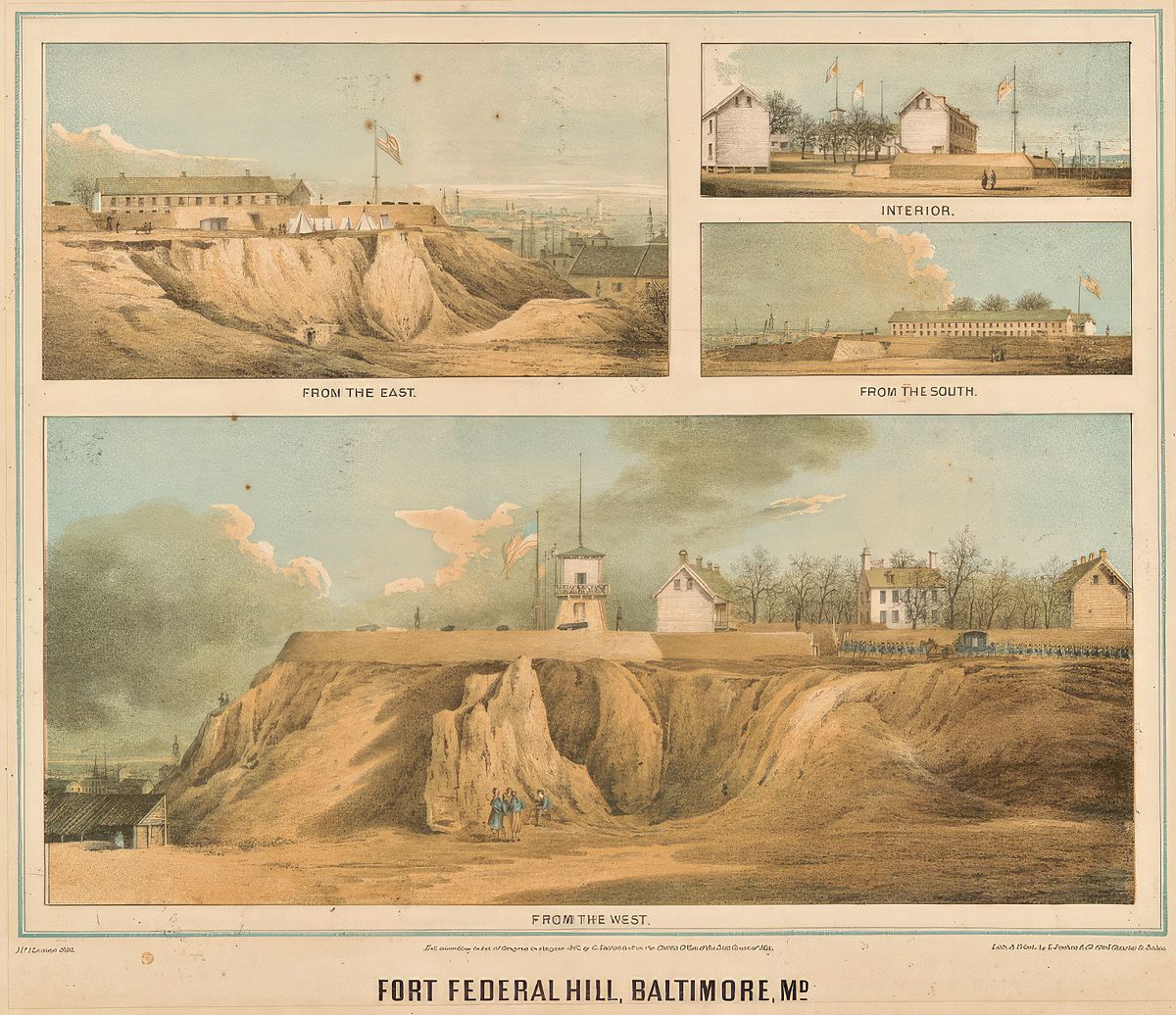
Fort Federal Hill The Graphic War highlights prints and printmakers from the Civil War discussing their meaning and the printmaker or artist’s goals. Englishman Captain John Smith noted it in 1608. He tagged it a “great red bank of clay” where, twenty-five years later, Lord Baltimore established his namesake colony with 140 hardy fellow travelers. Prior to the
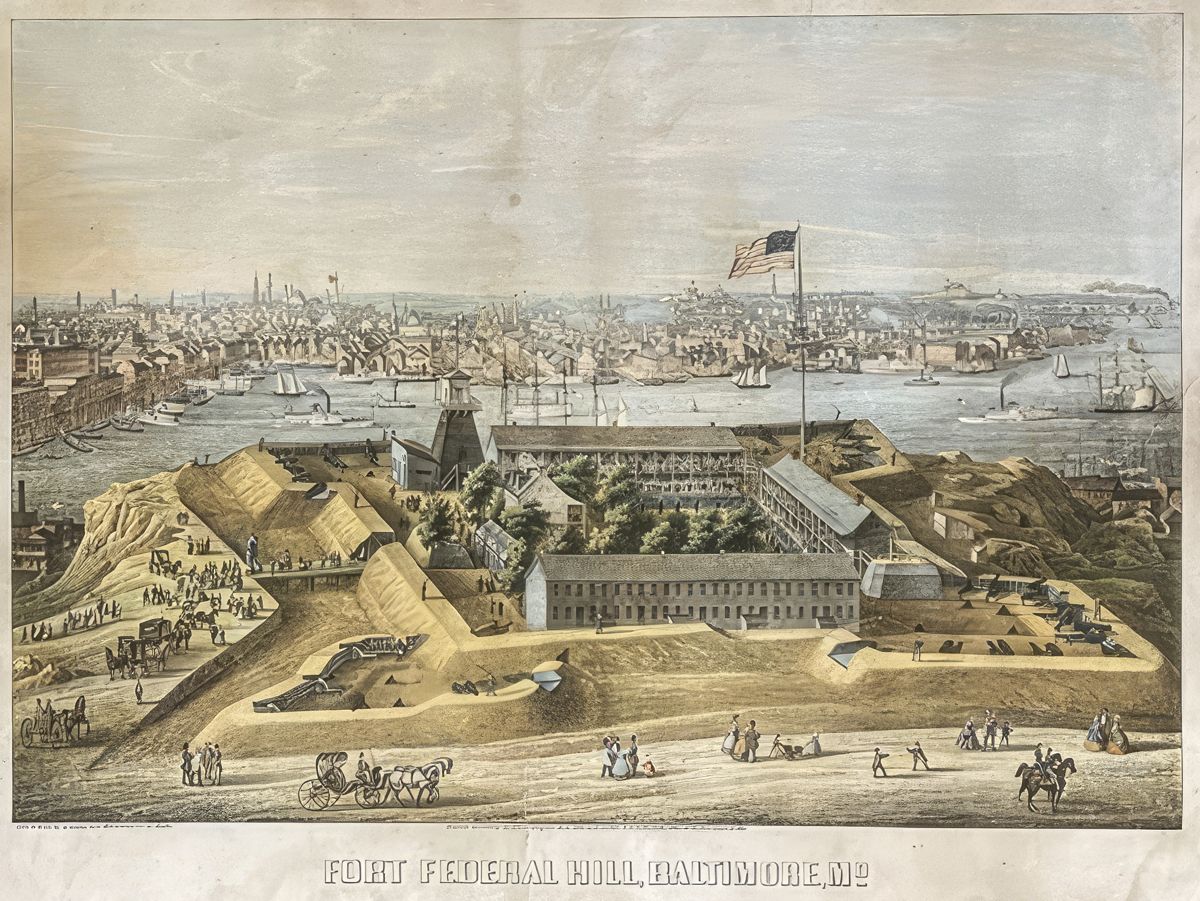
Revolution, the site served as a meeting ground and was viewed by all as a point of civic pride. According to one source, the site also supported a paint pigment mining operation.1 Maryland’s 1788 ratification of the Federal Constitution gave the hill its official name as a grand celebratory parade featuring 4,000 citizens, terminated at the site. Local merchants, to commemorate the moment, built a 15-foot ship called the “Federalist” that was pulled through the streets on a horse drawn cart. During the 19th century, “Baltimore merchants built a tower to watch for ships from Europe and Asia—an important feature of Baltimore’s mercantile heritage. Serving as a defensive stronghold during the War of 1812 and the Civil War, Federal Hill provided a panoramic view of Baltimore that lent itself well as a military outpost.”2 Over the years, the hill underwent several renovations, improvements, and expansions. Those modifications were captured by Baltimore lithographer Edward Sachse and are pictured in figure 1. Maryland entered the Civil War era as a much-divided border state. On April 19, Massachusetts troops passing through were attacked, provoking a city-wide riot. Nearly a month later, on the night of May 12, General Benjamin Butler “used a thousand men and a battery to occupy Federal Hill commanding the city, and seize some arms about to be shipped south. The movement was dramatically executed in thick darkness, amid a violent thunderstorm, the lightning gleaming on fixed bayonets.”3 Butler’s mission was “to insure the allegiance of the city and the state of Maryland to the Federal Government under threat of force.”4 Two months later, Colonel Abram Duryee’s Zouaves (Fifth New York Volunteer Infantry) replaced Butler and his troops. Duryee’s second in command Lieutenant Colonel Gouverneur Warren, proposed a more robust stronghold on Federal Hill. When Duryee was promoted and reassigned, Warren now in command, implemented his plans. His troops “constructed a massive earthworks around the fort site. By the end of October, 42 guns were mounted, including six 8-inch Columbiads and 22 32-pounders. Inside the ramparts, regimental carpenters built officers’ quarters and barracks to house 1,000 soldiers.”5 Tensions between the “town and fort” were often mitigated by colorful reviews and displays presented by the occupants of the fort to entertain local residents. The 7th New York performed an exhibition drill before “800 ladies and gentlemen…”. They “occupied the balconies of the barracks and had a fine view of the movements.” Disorderly soldiers, on other occasions, further inflamed tensions which were dealt with by Federal authorities.6 It was this re-enforced “fortress” that lithographer Edward Sachse (1804–1873) reproduced over and over again during the war. A native of Gorlitz, Germany, Sachse settled in Baltimore around 1840. He and his firm specialized in city views and rural sites.“Works include a 12-sheet aerial view of Baltimore that employed several artists over a three-year period. The firm also produced a four-sheet rendition of Syracuse, New York. Prints of Washington, DC, include a version of the Washington Monument that was planned but never built.”7 Sachse “also produced a series of views of American Civil War era military encampments and hospitals in Baltimore and Washington, DC. They were sold relatively cheaply to soldiers who would sometimes mark their tents on the maps and send them home. Sachse issued revised editions when units in the camps and setups changed.”8 Shown in Figure 2, is the first of four stages Sachse produced throughout the war. The earthworks surrounding the fort were printed in orange. The title margin merely reads “Fort Federal Hill, Baltimore, Md.” The first revision Sachse made (called edition 1) recognized the presence of new occupants: Garrisoned by the 129th Regt., N. Y. V. Col. P. A. Porter. The second state recognized the presence of the 7th Regiment National Guard, Marshall Lefferts, Col. commanding. The third stage sported green earthworks, wide borders, title only, no imprint or copyright lines. The fourth stage documented the arrival and encampment of the 131st Regiment of National Guard, O. S. M. July 4, 1864.9 There were eight documented fort commanders during the fouryear war. The last commander, Colonel Robert P. Kennedy, closed the fort and it was abandoned in August 1865. It had obviously served its purpose as Maryland remained loyal to the Union. The city purchased the property in 1880 and it is now included on the National Register of Historic Places. Today Federal Hill Park is a visitor destination offering panoramic views of the city. The Baltimore Department of Recreation and Parks report that “Monuments commemorating the Battle of Baltimore in 1814 enhance the Park—one is dedicated to U.S. senator and Maj. General Samuel Smith; another, to Lt. Colonel George Armistead, who was commander of Fort McHenry during the Battle of Baltimore in the War of 1812.”10 It seems there is no mention of “Beast” Butler and his role at Fort Federal Hill. Endnotes:
Federal Hill Baltimore, Wikipedia. https://en.wikipedia.org/wiki/Federal_Hill,_Baltimore Department of Recreation and Parks, Baltimore. https://bcrp.baltimorecity.gov/parks/federal-hill
CivilWarNews.com Allan Nevins, The War for the Union: The Improvised War, 1861–1862 (New York: Charles Scribner’s Sons, 1959), 87. 4. History of Fort Federal Hill. http://fortwiki.com/Fort_Federal_Hill. 5. Ibid. 6. Laura Rice, Maryland History in Prints 1743–1900. Maryland Historical Society, 2002, 251. 7. Wikipedia: https://en.wikipedia.org/wiki/Edward_Sachse 8. Ibid. 9. Lois McCauley, Maryland Historical Prints 1752–1889. Maryland Historical Society, 1975. 208-209. 10. Department of Recreation and Parks, Baltimore. https://bcrp.baltimorecity.gov/parks/federal-hill 3.
After 43 years in the museum field, Cilella devotes his time collecting American prints and maps and writing. His most recent books are Upton’s Regulars: A History of the 121st New York Volunteers in the Civil War (U. Press Kansas, 2009). His two-volume Correspondence of Major General Emory Upton, (U. of Tennessee Press, 2017), received the 2017–2018 American Civil War Museum’s Founders Award for outstanding editing of primary source materials. Upton’s love letters 1868-70, (Till Death Do Us Part) was published in 2020 by the Oklahoma University Press. His current book, the Memoirs of Dewitt Clinton Beckwith of Upton’s Regulars (McFarland Press) was released this spring.