
Critic's Corner
The Atlanta Appeal Justifies Fort Pillow
By Stephen Davis · Originally published April 2023 · pp. 26–29
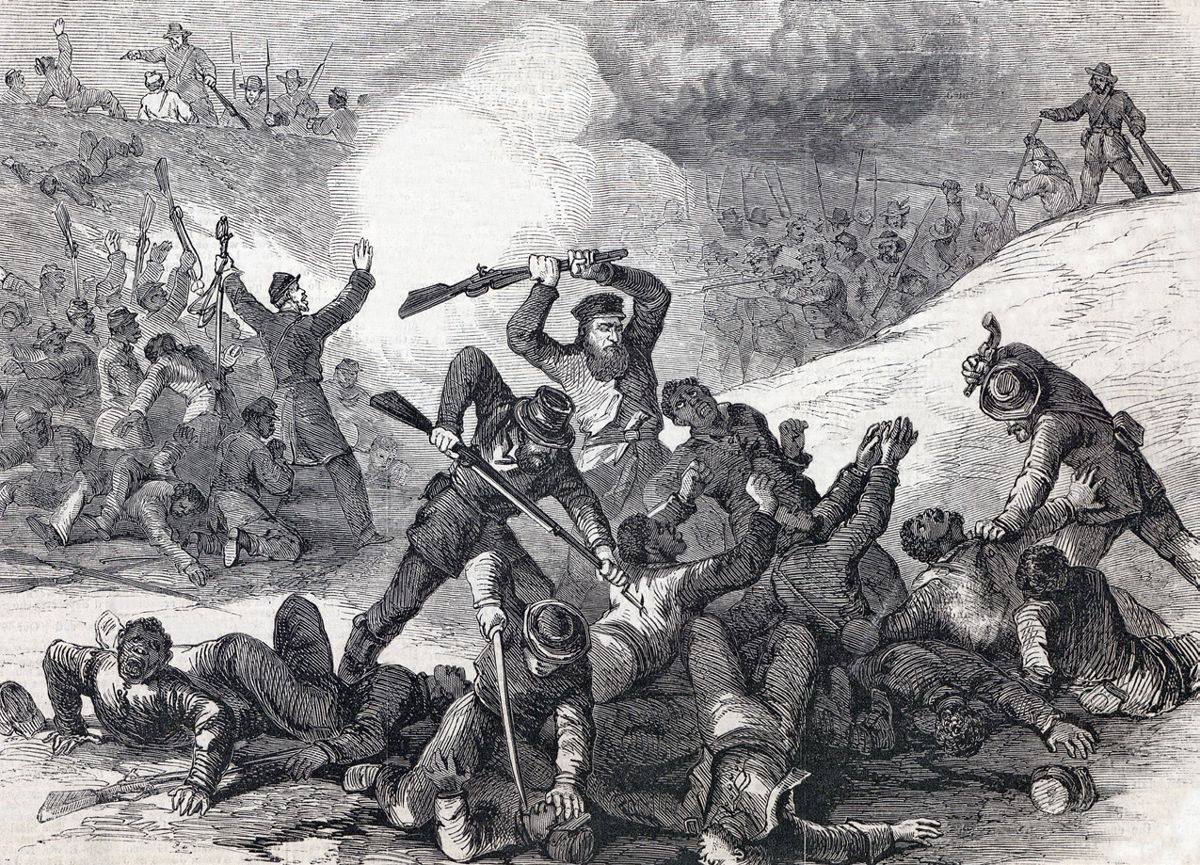
The Atlanta Appeal Justifies Fort Pillow
At the time of the war, Memphis’s four leading newspapers were the Appeal, Argus, Avalanche and Bulletin.1
After Federal forces captured Memphis in June 1862, the Avalanche continued operation, absorbing the Bulletin three months later. The Avalanche sometimes ran afoul of the occupiers, but managed to last through the war. The owners of the Argus also made it, as one historian has written, “by being very circumspect in their editorial policy.”2
The Appeal, however, pulled up stakes. Owners and editors were John R. McClanahan and Benjamin F. Dill, who refused to accept the prospect of being censored and controlled by Yankees. On June 6, 1862, even as a big naval battle raged offshore, McClanahan and Dill packed up and took off. They had already announced their intentions:
Lincoln’s hireling minions would deprive us of the privilege of expressing at all times our earnest God-speed to the progress of Southern independence…. Sooner would we sink our type, press and establishment in the bottom of the Mississippi river, and be wanderers and exiles from our homes.3
Wanderers and exiles, indeed. As the Confederacy shrank under Union conquest, the Appeal was forced to migrate further: first, to Grenada, Mississippi (June-November 1862); to Jackson (December 1862-May 1863); then to Meridian (one week); and on to Atlanta, where the Appeal resumed publication on June 6, 1863. All of this relocating by the paper led wags to start calling it the “Moving Appeal.”4
By midpoint in the war, Atlanta had become home to five newspapers. The Intelligencer had been founded in 1842 in Madison, Georgia; it moved to Atlanta five years later, locating downtown on Whitehall Street. It became a daily in 1854. The Southern Confederacy had been founded in 1857 as the National American; it got its new name on March 4, 1861 (the day of Lincoln’s inauguration). A third paper, the Commonwealth, limped behind the other two and folded in August 1863. Then came two more papers, refugees from Yankee conquerors: first the Appeal, then the Knoxville Register, which arrived in late August 1863.5
The Appeal was the quintessential Confederate newspaper. As such it celebrated Confederate victories, like that at Chickamauga, usually hyperbolically.6 It shrugged off Southern reverses, such as the fall of Vicksburg: “Come what may, we shall not despond, or despair of the Republic,” McClanahan vowed. “We have an abiding faith in the success of the South,” it proclaimed, as it pledged “a continued resistance to the tyranny which a haughty foe are endeavoring to establish over us.”7 Prominent in wartime propaganda was vilification of the enemy, and the Appeal did this, too, at one point calling Yankee bluebellies “azure-stomached miscegnators.”8
Events of April 12, 1864
Especially when the Northern press condemned Confederate actions, the Appeal always took up for the South. Such was the case with Fort Pillow.
Maj. Gen. Bedford Forrest and his cavalry had already conducted two raids into west Tennessee, when on March 15, 1864 he set forth once more from north Mississippi.9 Detachments were sent out to gobble up Union garrisons along the way while Forrest pressed ahead, reaching Paducah, Kentucky on March 25.10 He kept part of his forces, under Brig. Gen. James R. Chalmers, in west Tennessee to watch possible enemy advances from Memphis or Fort Pillow. By April 13-14, Confederates were still threatening Columbus and gathering horses at Paducah. Detachments kept Federals at Memphis while Forrest and Chalmers planned to move against Fort Pillow.11
The place had been constructed by Confederates in 1861 on a bluff overlooking the Mississippi forty miles north of Memphis. Federals occupying it in the spring of ’62 modified the earthwork; two years later it was garrisoned by 557 officers and men –half white, half colored—under Maj. Lionel F. Booth. Most of the whites were Tennessee Tories, tales of whose depredations on the local citizenry reached Forrest. Not surprisingly, the Saddle Wizard pledged to “attend to” the Fort Pillow garrison.12
Chalmers and some 1,500 troopers arrived before Fort Pillow at dawn on April 12. The Confederates drove in the outside skirmish line and surrounded the fort. Then from high ground and tree stumps they started picking off the garrison, zeroing in on officers. “We suffered pretty severely in the loss of commissioned officers by the unerring aim of the rebel sharpshooters,” one Federal stated. Major Booth was killed around 9 a.m.; his adjutant fell shortly after. “From that time on” Forrest biographer Robert Selph Henry writes, “the defense of the place was hopeless.”13
And so it was. As the Confederates kept up a steady fire on targets inside the fort, Forrest arrived at 10 o’clock to direct the final deployment of his men. A few hours later he sent in a demand for surrender, with his usual threat: “Should my demand be refused, I cannot be responsible for the fate of your command.” Maj. William F. Bradford, who had succeeded Booth, consulted with his officers, then sent back a note: “I will not surrender.”14
Upon receiving it around 3:15, Forrest ordered his bugler, Jacob Gaus, to sound the charge. Some 1,200 Southerners quickly covered the distance to the fort, jumped into the ditch, climbed up the parapet, and poured into the fort.15
With most of their officers gone, the overwhelmed Federals, white and black, fought as best they could, but most started fleeing out of the fort and down the riverbank. Forrest’s men continued firing as the Yankees plunged into the water. “The victory was complete,” Forrest wrote afterward; “the river was dyed with the blood of the slaughtered for 200 yards.”16 When it was all over, toward sundown, 41% of the Federals—231 of 557— were dead. Many drowned; others surrendered—or tried to. “There can be no doubt,” admits Forrest biographer Robert Selph Henry, “nor has it been denied, that some men—perhaps a considerable number—were shot after they, as individuals, were seeking to surrender.” Forrest’s casualties totaled 14 killed and 86 wounded.17
Talk of a massacre
The next day, with Confederates still holding the fort, two Northern vessels appeared offshore. A truce was arranged for the Federals to bury their dead and gather their wounded in and around the fort. These were put onboard one of the transports, the Platte Valley, which steamed upriver to the army hospital at Mound City, Illinois.18
The survivors spoke of a deliberate and wholesale massacre by Forrest’s men. The Federal commander at Cairo, Brig. Gen. Mason Brayman, sent to Secretary of War Edwin Stanton lengthy written and sworn testimony he had received alleging wholesale bloodshed. One black private claimed he saw a Federal soldier stabbed after he had surrendered. A store clerk in the fort stated he heard Rebel officers say that “they would never recognize negroes as prisoners of war, but would kill them whenever taken.” One Federal cavalryman responded in a question-and-answer setting that he heard Rebels shouting, “Give them no quarter; kill them; kill them; it is General Forrest’s orders.”19
A Memphis newspaper and the Associated Press quickly picked up on the story, which then spread throughout the Northern press. The Cincinnati Gazette called the bloody battle “one of the most horrible that has disgraced the history of modern warfare.” The New York Tribune asserted, “the Rebel leaders meant to impress upon this struggle every possible feature of cruelty.” On April 30, 1864, Harper’s Weekly rushed into its pages a woodcut illustration that showed Rebels shooting fallen black soldiers and bayoneting others; one unfortunate Negro is seen lying on the ground helpless as he is about to be stabbed in the back.20
So the Yankees claimed that there was “no quarter” shown by Forrest’s men at Fort Pillow. The allegation infuriated Southerners, even as they owned up to the bloodshed. The Mobile Advertiser and Register was one of the first Confederate newspapers to report the “indiscriminate slaughter,” and that “the fort ran with blood; many jumped into the river and drowned or [were] shot.” The Memphis/Atlanta Appeal spoke of the “unprecedented slaughter of five-sevenths of the garrison.”21
The Appeal’s take
Even acknowledging the bloodshed, the Confederate press sought to absolve Forrest of the Yankee libel that he had ordered a massacre, and took up all lines of counterargument. Many of them can be seen in the following editorial of the Memphis/Atlanta Appeal.
THE MURDER OF NEGRO TROOPS.
OKOLONA,
MISSISSIPPI, June 14, 1864.
There is but one fact significant above all others in connection with the recent victory of General Forrest—it is the first which has been won by the smaller over the larger force, where the inequality in numbers was so great that every participant in the struggle must have been conscious of the relative strength of the combatants. Strategy, Forrest’s name, and confidence in their leader, won the day. The Yankees and negroes opposed Forrest in Middle Tennessee, and came forth simply to slaughter the helpless, to plunder and desolate the country.
Forrest’s strength in the contest was about three thousand five hundred men. The number of negroes and whites is not accurately ascertained. Prisoners say that their force was twelve or fifteen thousand. Telegraphic despatches have given the general result of the battle, but many days must elapse before the details are known. Prisoners are constantly brought in by the country people. Very few negroes it seems have been captured. Perhaps not more than forty and fifty have appeared at headquarters. Most of them fled as soon as it was known that Forrest was on the battlefield. Those that were taken escaped. (?) The soldiers say that they “lost them.”
You must know that most of Forrest’s men are from Western Tennessee. Before the battle fugitives from the counties through which Sturgis and his troops were advancing, came into camp detailing incidents which made men shudder who are accustomed to scenes of violence and bloodshed. I cannot relate the stories of these poor frightened people. Robbery, rapine, and the assassination of men and women, were the least of crimes committed, while the “Avengers of Fort Pillow” overran and desolated the country. Rude unlettered men who had fought at Shiloh, and in many subsequent battles, wept like children when they heard of the enormities to which their mothers, sisters, and wives had been subjected by the negro mercenaries of Sturgis. The mildest, most peaceable of our soldiers became madmen when they heard how the persons of their kinswomen were violated. The negroes were [killed] regardless of the age, condition, sex, or entreaties of their victims. In one instance, the grandmother, daughter, and granddaughter, were each, in the same room, held by the drunken brutes, and subjected to outrages by the bare recital of which humanity is appalled. A young wife, enciente, taken to a negro encampment, and, tied to stakes driven in the ground, was made to minister to the hell-born passions of a dozen fiends. Death, in his mercy came to her relief. A little boy, who sought to defend his mother, was brutally bayoneted. When their savage lusts were gratified, the victims here and there were burned in their dwellings. Insanity, in some cases, came to the relief of sufferings such as never before were inflicted upon human creatures by remorseless fiends in human shape. Terror, and the agony of hopeless shame, and famine, and fire, and blood, and the assassination of the helpless and unoffending, marked the progress of the “Avengers of Fort Pillow.” It is not strange that negro prisoners were “lost.” The whites who led them on and incited them to these damnable deeds deserve a more terrible punishment. Yet we have sent three thousand of those white men to prison to be exchanged. Simple justice demands their instant execution by the hangman’s rope.
You have heard that our soldiers buried negroes alive at Fort Pillow. This is true. At the first fire after Forrest’s men scaled the walls, many of the negroes threw down their arms and fell as if they were dead. They perished in the pretence, and could only be restored at the point of the bayonet. To resuscitate some of them, more terrified than the rest, they were rolled into the trenches made as receptacles for the fallen. Vitality was not restored till breathing was obstructed, and then the resurrection began. On these facts is based the pretext for the crimes committed by Sturgis, Grierson, and their followers. You must remember, too, that in the extremity of their terror, or for other reasons, the Yankees and negroes at Fort Pillow neglected to haul down their flag. In truth relying upon their gunboats, the offices expected to annihilate our forces after we had entered the fortifications. They did not intend to surrender.
A terrible retribution, in any event, has befallen the ignorant, deluded Africans.22
So therein lay the Southern argument. Fort Pillow’s garrison of white Tennessee traitors and black recruits/former slaves had wreaked vengeance on the defenseless citizenry in the nearby area through murder, rape and robbery. They apparently called themselves the “Avengers of Fort Pillow,” part of the Union force based at Memphis under the command of Brig. Gen. Samuel D. Sturgis. Rape was a term not commonly used in Victorian America, but the Appeal’s reference to “the hell-born passions of a dozen fiends” would have been unmistaken by its readers; today a newspaper would simply refer to the gang rape of a young pregnant woman. It was this set of men who needed “attending to.”
Forrest was credited with a great victory because the Appeal got the numbers all wrong; The Yankees numbered a little over 500, not 12,000-15,000; Forrest and Chalmers had 1,500 men, not 3,500.
Losin’ ‘em
Then there was the fate of the prisoners, whom Confederates claimed “escaped.” Even the Appeal had to insert a question mark after that claim.
Truer was the statement that Forrest’s men had “lost them.” “Lost them” was a euphemistic phrase used by Confederate when they executed Union prisoners. In The War-Time Journal of a Georgia Girl (1908), Eliza Frances Andrews describes her conversation in late 1864 with a Southern soldier, Sam Weller, who told her how, after capturing some of Sherman’s men, they “just took ‘em out in the woods and lost ‘em.”
”Ever heerd o’ losin’ men, lady?” he asked.
“Yes,” she answered.
“What was the process of losing?” another inquired. “Did they manage the business with firearms?”
“Sometimes, when they was in a hurry,” Weller answered; “the guns would go off an’ shoot ‘em, in spite of all that our folks could do.”23
“It is not strange that negro prisoners were “lost,” the Appeal judged, and suggested that the black troops had been egged on by white officers, who deserved the same fate.
Regardless of cause or context, the Appeal’s conclusion was unassailable: a terrible retribution had befallen the Federal garrison of Fort Pillow.
Northerners’ outrage led Washington to order a Congressional inquiry. Two Republicans, Senator Benjamin F. Wade of Ohio and Representative Daniel W. Gooch, from Massachusetts, traveled to Cairo in late April to interview survivors.
The interrogations and testimony were carefully transcribed during Wade and Gooch’s time west, April 22-May 2, during which they held interviews at Cairo and Mound City, Illinois, Columbus, Kentucky, as well as at Fort Pillow and Memphis. When they returned to Washington, they submitted their findings. Congress viewed the whole thing so explosive that it authorized sixty thousand copies to be printed and distributed.24
The Congressional report
To judge from the tone of their questions, Wade and Gooch were out to skewer the Rebels—and they succeeded. They concluded that there was definitely a massacre at Fort Pillow, and that it was a product of malignant Rebel policy not to recognize blacks as soldiers. The report accused Forrest’s men of stealthily advancing during the truce; that when the Rebels charged they yelled out “no quarter.” When the garrison troops started running for the river, “the rebels commenced an indiscriminate slaughter,” even of women and children in the fort. Cries of “Kill the damned niggers; shoot them down” were heard. “All who asked for mercy were answered by the most cruel taunts and sneers.” Tents containing wounded were set on fire. One man, they claimed, was nailed to an outbuilding which was then torched. The next morning, April 13, the report continued, Rebels roamed about looking for wounded men, whom they then shot. When they began burying the dead, Rebels threw into the ditch some wounded men, still living. Major Bradford had survived the fight, but Wade and Gooch claimed that he was shot the next day as a “home-made Yankee,” detested by Forrest’s Tennesseans.25
Forrest’s riposte
The arguing stretched for decades after the war. A central Southern allegation was that the black troops had been given whisky to strengthen their nerves against the impending assault. “The negroes were drunk,” claimed one former Confederate, “and, when Forrest’s men got into the fort, the negroes continued to fight until they were overpowered.” “Many of the prisoners were drunk,” wrote James Dinkins as late as 1925; “a number of barrels of whisky were found at convenient points in the fort with tin dippers for use of the Federal soldiers.”26
Defenders of Forrest put forth various other arguments. The Southern Historical Society Papers in 1879 took satisfaction in printing a letter from Dr. Charles Fitch, fort surgeon, to General Chalmers, refuting the outrageous story that he had killed a baby in the fort battle.27
William Witherspoon served in the 7th Tennessee Cavalry, and in 1906 published Tishomingo Creek or Bryce’s Cross Roads, which included a passage on Pillow. “The Fort Pillow affair is not, by long odds, what it is reported to be by the Yankee side of the house, and our own (Southern) make too many apologies,” he began. “It needs none.”
The negroes had blue buckets (the common water bucket at that time) filled with whiskey and tin dippers (to drink with) passed around on their line on the breastworks, and were drinking and making sport and contumely remarks of our boys lying in line and in front and near them, while the first flag of truce was pending. The fact (about the whiskey) was reported to General Forrest; he said, “I will give them time to get drunk,” and sent the second flag.
The object was accomplished—the negroes got drunk. Major Booth, the commander, the only soldier and gentleman in the fort, was killed at the first of the fight, left the negroes without a head. The white element were all Tennessee home-made Yanks—who had joined the Federals not through any sense of patriotism, but for booty and plunder, and as bad as the worst Yank could do in their line, and they were pretty adept, the home-made Yank could beat him two to one.28
Another able advocate was Maj. Charles W. Anderson, Forrest’s adjutant and inspector-general, who prepared a detailed account of the events at Fort Pillow published in Confederate Veteran in 1895, a generation after the war (showing that the controversy was still red-hot). Anderson essentially put the blame on the Federals, Major Bradford particularly, for refusing Forrest’s surrender demand and failing to have the garrison flag lowered after the fort was overrun. According to Anderson’s argument, this entitled Forrest’s men to keep firing even as individual garrison members sought to surrender. As soon as the Stars and Stripes was lowered, “firing was promptly stopped.” His conclusion was pointed:
The charges against Gen. Forrest and his men of massacre and butchery at fort Pillow are outrageously unjust and unfounded. He did everything in his power to induce a surrender and avoid an assault. Thrice was a surrender demanded, and as often refused. There never was any surrender, therefore no massacre after surrender, as has been so erroneously and widely charged.29
What Forrest’s biographers say
Surprise, surprise: Forrest’s life-chroniclers take his side, and without subtlety. First, from Jordan and Pryor (1868):
We submit to the candid and those who are capable of accepting the truth that, in what occurred after the Confederates stormed the trenches, there was neither cruel purpose not cruel negligence of duty, neither intention nor inadvertence, on the part of General Forrest, whose course, therefore, stands utterly devoid of the essence of outrage or wrong.30
Dr. Wyeth (1899) sifted through all the testimony, and concluded “no cruelties were practiced by Forrest’s men upon any prisoner, wounded or unwounded.”31
Former Confederate infantry captain J. Harvey Mathes wrote a Forrest biography for Appleton’s “Great Commanders” Series (1902). Remember the My Lai massacre? Reading Mathes’ efforts to contextualize Fort Pillow reminds me of the American press’ efforts to explain the conduct of Captain Calley’s men. Forrest’s men had ridden all night, and were on the move all morning as they approached the fort. During the truce, the blacks inside “were very defiant and insulting in language and grimaces.” Finally, the enemy’s determination to make an “insane defense of a fort which they knew they could take,” was a further irritant, especially as the assault of any fort, regardless of the number of assailants, meant that some of them would fall. Thus the ensuing battle was “a terrific slaughter”—but no premeditated massacre, certainly not one ordered by the Confederate commander.32
H. J. Eckenrode wrote a biography for young readers that appeared in 1918. In it he points to the Federals garrison’s failure to surrender after the fort had been overrun, and to the continued shooting by black soldiers; “most of these foolhardy men were killed by enraged cavalrymen.” But there was no ordered massacre.33
The Englishman Eric Sheppard (1930) concluded, “a dispassionate consideration of the whole controversy leads one to conclude that while no organized massacre or measures of barbarity or severity were ordered by Forrest or any of his subordinate officers,” he blamed the general and his subordinates for having taken no steps to shield the garrison from “the manifestations of the very natural feelings of personal hatred and desire for vengeance which animated many of their men.”34
Andrew Nelson Lytle is without doubt the most literary of Forrest’s biographers. A Tennessean, he was a novelist, editor and critic, as judged by a 1984 essay in The Southern Review, “‘Three Ways of Making a Saint’: A Reading of Gustave Flaubert’s Three Tales.” Lytle was one of the Nashville Agrarians, the Fugitives who collaborated on I’ll Take My Stand (1930). As the group began planning their critique of American society, Donald Davidson wrote to John Crowe Ransom, “Andrew Lytle is terrifically interested, but he has to get his Forrest biography out of the way before all else.” 35
In his biography of Forrest, (1931), Lytle builds up the circumstances for a bloodletting.
Approaching Fort Pillow, Chalmers’ troopers had ridden all Sunday night (April 10), Monday and Monday night, before arriving s the fort around dawn on Tuesday, the twelfth. So the attackers were exhausted, and had reason to be vengeful. Writing of the Yankee garrison, Lytle declares, “many of the troops were known to be deserters from the Confederate armies, and they all had been a menace to West Tennessee”—an oblique reference to the depredations upon the people that the Atlanta Appeal referred to.36
Robert Selph Henry’s “First With the Most” Forrest (1944) is the first modern, thorough biography of the general, and to some it remains the best. His judgment on the matter is therefore important. “There can be no doubt, nor has it ever been denied,” he concludes, “that some men—perhaps a considerable number—were shot after they, as individuals, were seeking to surrender.” But Forrest did not order any sort of massacre; in fact, when he saw the Federal flag fall, he “promptly ordered all firing to cease.”37
Then there are three recent works. Brian Steel Wills, in A Battle from the Start: The Life of Nathan Bedford Forrest (1992), concludes that at Fort Pillow “people died who were attempting to surrender and should have been spared.” But he exonerates Forrest on the charge of ordering wholesale or premeditated massacre: “had Bedford Forrest wanted to annihilate the garrison, he could have easily done so and would certainly have supervised the operation personally.”38
In Nathan Bedford Forrest: A Biography (1993), Jack Hurst cites pro and con as to Forrest’s culpability. He quotes a letter from Sgt. Achilles Clark of the 20th Tennessee Cavalry to his sisters, dated April 14, in which Clark claimed the general “ordered them shot down like dogs.” In truth, the sergeant had written, “I with several others tried to stop the butchery and at one time had partially succeeded. But Gen. Forrest ordered them shot down like dogs—and the carnage continued. Finally our men became sick of blood and the firing ceased.” Yet Hurst also quotes Confederate Samuel H. Caldwell, who wrote his wife that the enemy “refused to surrender—which incensed our men & if General Forrest had not run between our men and the Yanks with his pistol and sabre drawn not a man would have been spared.”39
Davison and Foxx are unequivocal. “There is no evidence that anything vaguely resembling a massacre of surrendering troops had ever been perpetrated upon Forrest’s orders,” they declare; “there is no record that he gave such orders or made any plans to exterminate these troops.”40
Fort Pillow just won’t go away; I count six books on the battle in the last generation: Gregory J. Macaluso, The Fort Pillow Massacre: The Reason Why (1989); Richard L. Fuchs, An Unerring Fire: The Massacre at Fort Pillow (1994); John Gauss, Black Flag! Black Flag! (2003); John Cimprich, Fort Pillow (2005); Andrew Ward, River Run Red (2005); and Brian Steel Wills, The River Was Dyed with Blood (2014). There are even novels: Perry Lentz, The Falling Hills (1967), James Sherburne, The Way to Fort Pillow (1972) and Fort Pillow (2006) by the redoubtable Harry Turtledove.
Among the tons of articles on the subject, my favorite is still Albert Castel’s in Civil War History (March 1958). In it he quotes Dudley Cornish’s The Sable Arm (1956), in which the historian declares, “It has been asserted again and again that Forrest did not order a massacre.” Given the enemy garrison he faced—half Tennesseans-turned-traitor, the other half ex-slaves fighting their former masters— Cornish dismisses the whole thing by concluding, “he did not need to.”41
Notes
-
J. Cutler Andrews, The South Reports the Civil War (Princeton: Princeton University Press, 1970), 40.
-
Thomas Harrison Baker, The Memphis Commercial Appeal: The History of a Southern Newspaper (Baton Rouge: Louisiana State University Press, 1971), 95.
-
Thomas H. Baker, “Refugee Newspaper: The Memphis Daily Appeal, 1862-1865,” Journal of Southern History, vol. 29, no. 3 (August 1963), 326.
-
Rod Sowalter, “News on the Run: J. R. McClanahan and “The Moving Appeal,” America’s Civil War, vol. 32, no. 1 (March 2019), 16-17; B. Kimball Baker, “The Memphis Appeal,” Civil War Times Illustrated, vol. 18, no. 4 (July 1979), 32-35.
-
Stephen Davis, “Atlanta’s Wartime Newspapers,” Civil War News, vol. 48, no. 4 (April 2022), 6.
-
B. G. Ellis, The Moving Appeal: Mr. McClanahan, Mrs. Dill, and the Civil War’s Great Newspaper Run (Macon: Mercer University Press, 2003), 249.
-
R. A. Halley, “A Rebel Newspaper’s War Story: Being a Narrative of the War History of the Memphis Appeal,” Tennessee Old and New, 2 vols. (Nashville: Tennessee Historical Society, 1947), vol. 1, 248, 263.
-
Stephen Davis, What the Yankees Did to Us: Sherman’s Bombardment and Wrecking of Atlanta (Macon: Mercer University Press, 2012), 72n.
-
John Allan Wyeth, Life of General Nathan Bedford Forrest (Dayton OH: Press of Morningside Bookshop, 1975 [1899]), 326.
-
Eddy W. Davison and Daniel Foxx, Nathan Bedford Forrest: In Search of an Enigma (Gretna LA: Pelican Publishing Company, 2007), 219.
-
Andrew Nelson Lytle, Bedford Forrest and His Critter Company (Seminole FL: Green Key Press, 1984 [1931]). 273-76.
-
Robert Selph Henry, “First With the Most” Forrest (Jackson TN: McCowat Mercer Press 1969 [1944]), 249; Eric William Sheppard, Bedford Forrest: The Confederacy’s Greatest Cavalryman (Dayton OH: Morningside, 1988 [1930]), 165.
-
Henry, Forrest, 250-51.
-
Brian Steel Wills, A Battle from the Start: The Life of Nathan Bedford Forrest (New York: HarperCollins, 1992), 181-83.
-
Davison and Foxx, Forrest, 232.
-
Wills, Forrest, 183-85.
-
Henry, Forrest, 256; Albert Castel, “The Fort Pillow Massacre: A Fresh Examination of the Evidence” in Castel, Winning and Losing in the Civil War: Essays and Stories (Columbia: University of South Carolina Press, 1996), 44.
-
John Cimprich, Fort Pillow: A Civil War Massacre and Public Memory (Baton Rouge: Louisiana State University Press, 2005), 86-87.
-
Brayman to Stanton, April 28, 1864, OR, vol. 32, pt.1, 518-21, 525.
-
Brian Steel Wills, The River Was Dyed with Blood: Nathan Bedford Forrest & Fort Pillow (Norman: University of Oklahoma Press, 2014), 165.
-
Cimprich, Fort Pillow, 96.
-
“The Murder of Negro Troops,” Memphis/Atlanta Appeal, July 1864, in Frank Moore, ed., Rebellion Record: A Diary of American Events, 11 vols. (New York: G. P. Putnam, 1861-63; D. Van Nostrand, 1864-68), vol. 11, 525-26.
-
Eliza Frances Andrews, The War-Time Journal of a Georgia Girl 1864-1865 (Macon: Ardivan Press, 1960 [1908]), 30-31.
-
Cimprich, Fort Pillow, 97-99.
-
Joint Committee on the Conduct of the War, Report of the Joint Committee on the Conduct of the War at the Second session, Thirty-eighth Congress (Washington: Government Printing Office, 1865), 1-6.
-
Charles W. Anderson, “The True Story of Fort Pillow,” Confederate Veteran, vol. 3, no. 11 (November 1895), 322-26; James Dinkins, “The Capture of Fort Pillow,” Confederate Veteran vol. 33, no. 12 (December 1925), 462.
-
“Capture of Fort Pillow— Vindication of General Chalmers by a Federal Officer,” Southern Historical Society Papers, vol. 7 (1879), 439-41.
-
William Witherspoon, Tishomingo Creek or Bryce’s Cross Roads (Jackson TN: published by author, 1906), excerpt in Robert Selph Henry, As They Saw Forrest: Some Recollections and Comments of Contemporaries (Jackson TN: McCowat-Mercer Press, 1956), 125-26.
-
Anderson, “Fort Pillow,” 326.
-
Thomas Jordan and J. P. Pryor, The Campaigns of Lieut.-Gen. N. B. Forrest, and of Forrest’s Cavalry (Dayton OH: Press of Morningside Bookshop 1977 [1868]), 453.
-
Wyeth, Forrest, 383.
-
J. Harvey Mathes, General Forrest (New York: D. Appleton, 1902), 224.
-
H. J. Eckenrode, Life of Nathan B. Forrest (Richmond: B. F. Johnson, 1918), 98.
-
Eric William Sheppard, Bedford Forrest: The Confederacy’s Greatest Cavalryman (Dayton OH: Morningside, 1988 [1930]), 172.
-
Louis D. Rubin, Jr., The Wary Fugitives: Four Poets and the South (Baton Rouge: Louisiana State University Press, 1978), 136.
-
Andrew Lytle, Bedford Forrest and His Critter Company (Seminole FL: Green Key Press, 1984 [1931]), 276-277.
-
Henry, Forrest, 256.
-
Wills, Forrest, 196.
-
Jack Hurst, Nathan Bedford Forrest (New York: Alfred A. Knopf, 1993), 176; Dan E. Pomeroy, ed., “A Letter of Account: Sergeant Clark Tells of the Fort Pillow Massacre,” Civil War Times Illustrated, vol. 24, no. 4 (June 1985), 24-25.
-
Davison and Foxx, Forrest, 243.
-
Dudley Taylor Cornish, The Sable Arm: Negro Troops in the Union Army, 1861-1865 (New York: W. W. Norton, 1966 [1956]), 175.
Stephen Davis’ next book, on how the National Intelligencer covered the Atlanta Campaign, will be published by Savas Beatie later this year.