
Through The Lens
Tattered, Battered, Bareheaded, And Blood-Smeared
By Stephanie Hagiwara · Originally published April 2023 · pp. 18–19
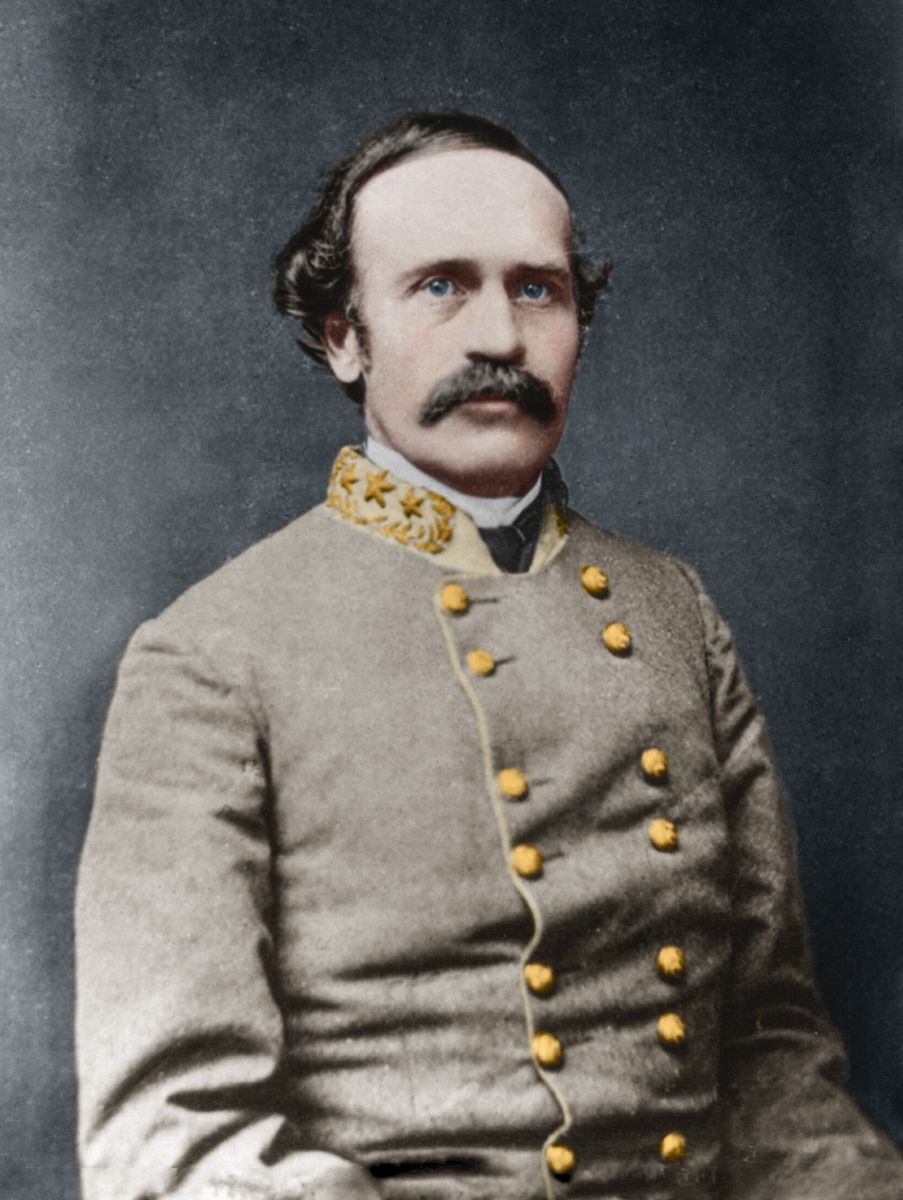
Tattered, Battered, Bareheaded, And Blood-Smeared “Once more! Try the steel! Hell for ten minutes and we are out of it!” – U.S. Gen. Joshua Chamberlain By late March 1865, the Siege of Petersburg, Va., was winding to a close. The Confederate supply lines to Petersburg had dwindled to two; the South Side Railroad and the Boydton Plank Road. U.S. Gen. Ulysses S. Grant’s Army of the Potomac was driving C.S. Gen. Robert E. Lee to abandon Petersburg and the nearby capitol of Richmond. Lee had delayed joining Gen. Joseph Johnston’s army in North Carolina due his lack of sufficient horsepower to move his artillery and wagons over the rain-soaked roads. On March 29, Grant launched his Spring Campaign with generals Gouverneur Warren’s V Corps, Andrew Humphreys’ II Corps, and Philip Sheridan’s cavalry. The infantry was to march five miles west, flanking the Confederate lines, then turning north to drive the Rebels from their trenches. The cavalry would swing below, around the infantry, proceed north from the Dinwiddie Court House, and get behind Confederate lines. Grant made it clear that the infantry was to support the cavalry. At 3:00 a.m., the V Corps left camp as quietly as they could. Reveille was not sounded or fires lit. The Federals “… went slipping and plunging through the black slimy mud in which pointed rocks were bedded.” At 10:20 a.m., Gen. George G. Meade revised Warren’s orders due to Humphreys’ II Corps being delayed. Warren was to cross Gravelly Run using Quaker Road instead of Boydton Plank Road. Warren replied that “my skirmishers are
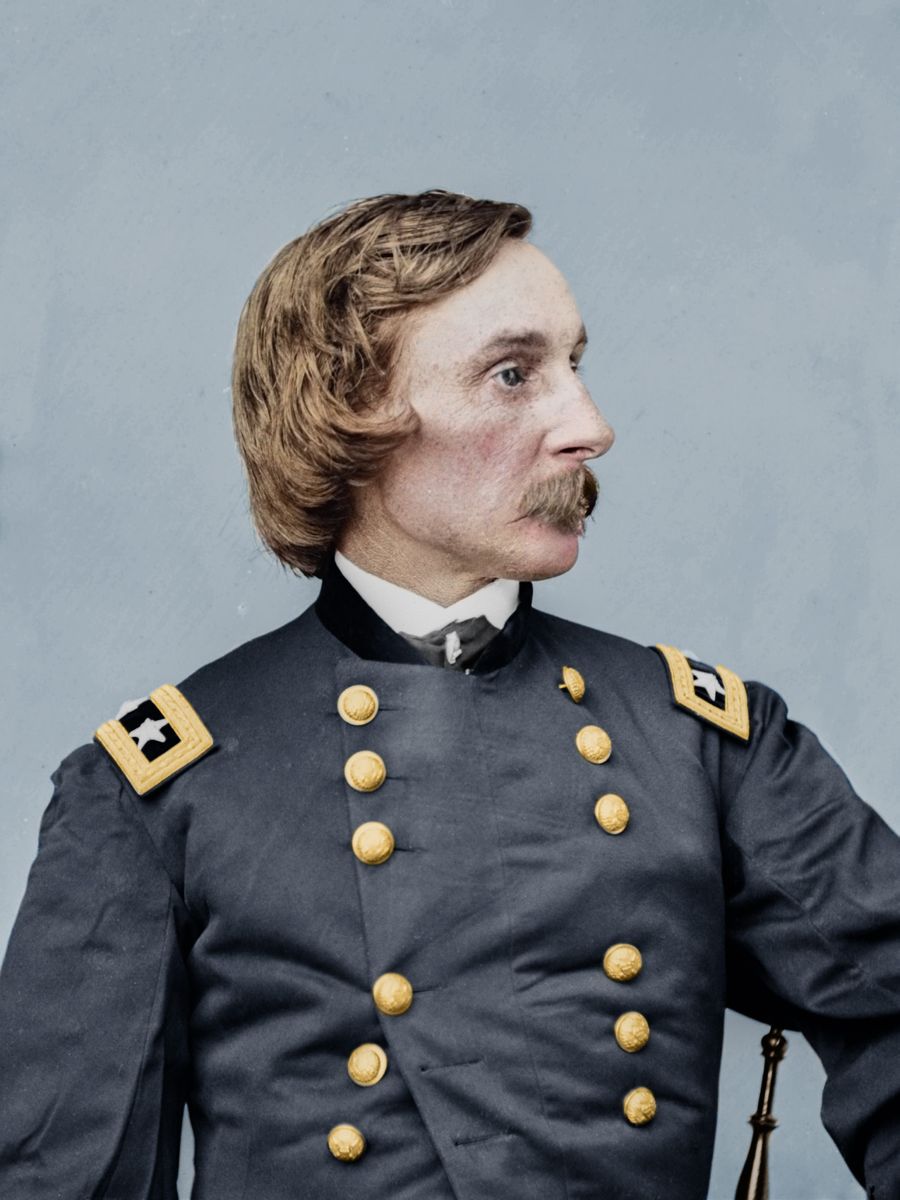
Gen. Gouverneur Warren. Colorization © 2023 (Library of Congress)
out on the Quaker Road as far as Gravelly Run. They had been ordered there, and I’ll see that it is done.” Meade responded, “that you did not understand his last order.” Warren’s entire V Corps., not just the skirmishers, were to take the revised route. As Col. Charles S. Wainwright, Battery B, 4th U.S. Artillery, wrote, Warren would be “moving farther off from Sheridan, whose operations we were supposed to be supporting…” C.S. Gen. Bushrod Rust Johnson’s Division had to protect more than three miles of trenches at the extreme right of Lee’s forces. West Point graduate Johnson was born in Ohio and raised as a Quaker. He had fought in the Seminole War in Florida and the Mexican-American War. Afterwards, as a college professor, he taught in Kentucky and Tennessee and was active in their state militias. Johnson’s 4800 dispirited men were hungry and ragged, their
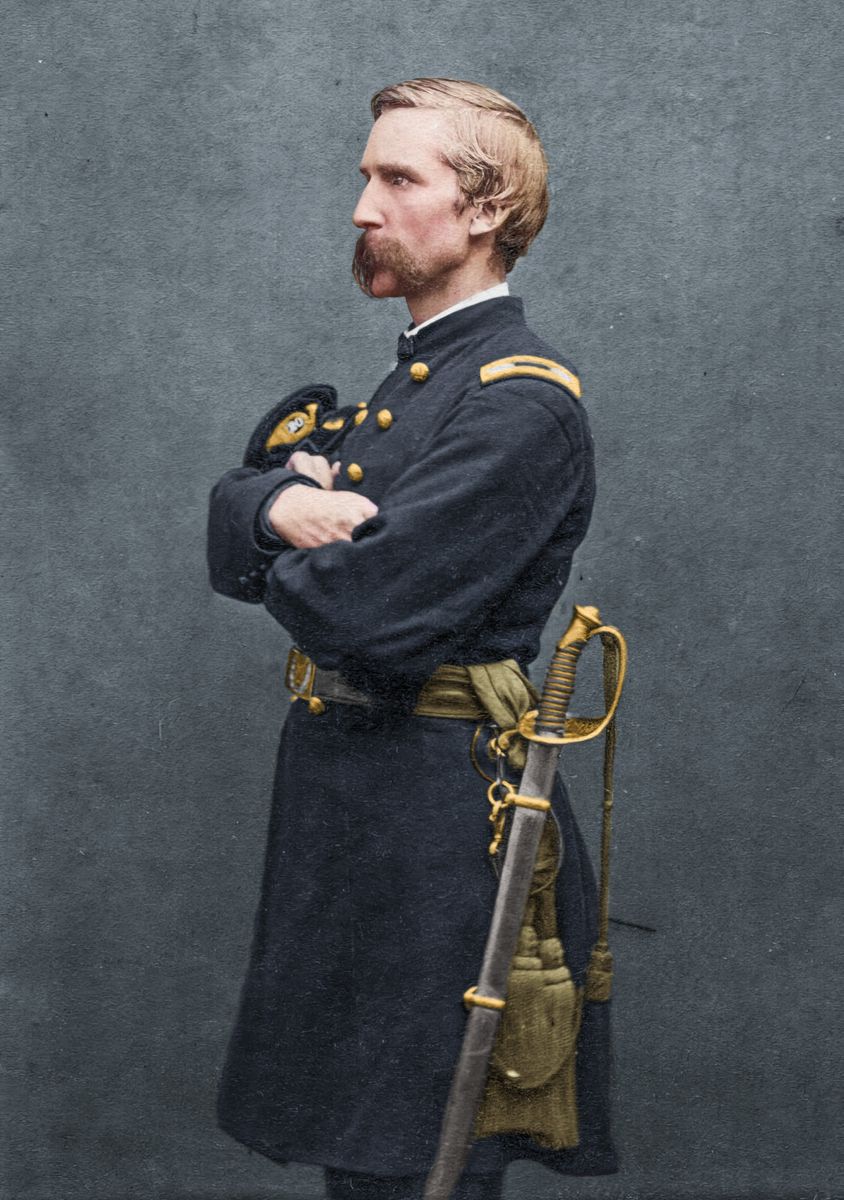
Gen. Joshua Chamberlain. Colorization © 2023 (Public Domain) lines stretched too thin. The division had little more than one man per yard of defensive line, leaving the area vulnerable to attack. The Federals were enticing deserters by paying “at the rate of $8 per arm.” The Army of Potomac’s Chief Ordnance Officer had $10,000 sent to facilitate these purchases. Deserters were slipping away in groups. Realizing Grant’s army was on the move, Lee sent Johnson to the breastworks guarding Boydton Plank Road. Johnson positioned the brigades of generals Samuel McGowan on the right, Col. M.L. Stansel’s regiment from Young Moody’s in the center, Eppa Hunton on the left and Henry Wise as the reserve. Resolved to hold the outpost protecting the vital junction of White Oak and Boydton Plank Road, Lee rode over to join them. The March 29, Battle of Lewis Farm began with Gen. Joshua Chamberlain, 1st Division, V Corps, leading the attack. A prewar college professor of modern languages, Chamberlain is best known for holding Little Round Top on July 2, 1863, during the Battle of Gettysburg, Penn. Six months earlier, Chamberlain had returned to the field after being critically shot during the June 18, 1864, Second Battle of Petersburg. He used his sword to hold himself upright as he encouraged his men to hold the line before collapsing from blood loss. Chamberlain received a Brigadier-General battlefield promotion on what was thought to be his death bed. While Gen. Charles Griffin’s pioneers rebuilt the Gravelly Run bridge, Chamberlain positioned generals Edgar M. Gregory on the left, Joseph Bartlett to be ready as required, and Horatio Sickel on the right below the bridge “to pour hot fire upon the enemy opposite.” Chamberlain with the rest of his 1,750 men, crossed the waist-deep stream above the bridge. “Major [E. A.] Glenn with his six companies in skirmishing order dashed through the stream and struck the enemy’s breastworks front and flank. … The whole command swept onward like a wave, carrying all before it a mile or more up the road, to the buildings of the Lewis Farm.” Under hot fire, between 3 and 4 p.m. Chamberlain’s men had reached the old sawmill when Chamberlain’s horse reared up, catching a bullet that passed through its neck, into “a leather case of field orders and a brass-mounted hand-mirror in my [left] breast-pocket … demolished the pistol in the belt of my aide Lieutenant Vogel, and knocked him out of the saddle. … The bullet continued down Chamberlain’s sleeve, “bruised and battered my bridle arm so that it was useless, … it had followed around two ribs so as to come out at the back seam of my coat. The horse was bleeding profusely.” Knocked unconscious, “the first thing I knew an arm was around my waist and words murmured in my ear, ‘My dear General, you are gone,’” said Griffin. Chamberlain simultaneously heard, “a wild rebel yell” and saw the Federal line breaking. Chamberlain “… rose in the saddle tattered and battered, bareheaded and bloodsmeared. I swung the rein against my horse’s wounded neck and lightly touching his flank with my heel, we made a dash for the rally of our right.” The Confederates again advanced, pushing the Federals “entirely out of the woods to a direction parallel with the road by which we advanced.” Word was sent if they could hold on, Griffin would bring up the artillery. The Federals endured. Battery B, 4th U.S. Artillery, came thundering up with their Napoleons. “The two guns opened with canister at once, doing splendid service. … the rebel yell ceased, and the next moment our men hurrahed.” Four
CivilWarNews.com additional regiments arrived, pushing the Confederates back. According to Johnson, “Our troops persistently continued to fight, but were unable to advance, and orders were first sent to hold the position they had gained. It, however, became evident that our troops were being exhausted, and needed re-enforcements, of which there was none available.” About 5 p.m. the Confederates withdrew to their morning position at the main breastworks. Lee’s Boydton Plank Road supply line had been permanently cut. The V Corps would continue to move forward on White Oak Road towards that meeting place of roads, Five Forks. Sensing the end was near, Grant ordered the cavalry to forget attacking the railroads; stay close to the infantry. After the battle, Warren came up to Chamberlain, still wearing his bloody, bullet riddled clothes. “General,” he says, “you have done splendid work. I am telegraphing the President. You will hear from it.” Chamberlain soon received a brevet commission of Major-General. Sources: • Chamberlain, Major-General Joshua L. The Passing Of The Armies: An Account Of The Final Campaign Of The Army Of The Potomac, Based Upon Personal Reminiscences Of The Fifth Army Corps. Golden
Portion of base map: Manuscript on file at Petersburg National Battlefield, National Park Service: Ed Bearss Troop Movement Maps, Boydton Plank Road Base Map. Additional Union and Confederate earthworks and troop movements added by Brett Schulte. Unit placement is solely based on an original map found in The Petersburg Campaign, Volume II: The Western Front Battles by Ed Bearss and Bryce Suderow, p. 343.
•
•
•
•

Springs Publishing, 2015 Cummings, Charles M.. “Yankee Quaker Confederate General: The Curious Career of Bushrod Rust Johnson.” Blue & Gray Magazine/The General’s Books, 1993 Wainwright, Colonel Charles S.. A Diary Of Battle; The Personal Journals Of Colonel Charles S. Wainwright, 1861–1865. Golden Springs Publishing, 1962 Korn, Jerry, and the Editors of Time-Life Books. Pursuit To Appomattox: The Last Battles, Time-Life Books, Alexandria, VA, 1987 Jordan, David M. “Happiness Is Not My Companion”: The Life of General G. K. Warren, Indiana University Press, 2001
Stephanie Hagiwara is the editor for Civil War in Color.com and Civil War in 3D.com. She also writes a column for History in Full Color.com that covers stories of photographs of historical interest from the 1850’s to the present. Her articles can be found on Facebook, Tumblr and Pinterest.