
The Graphic War
Execution of Sioux Indians
By Salvatore Cilella · Originally published April 2023 · pp. 24–25
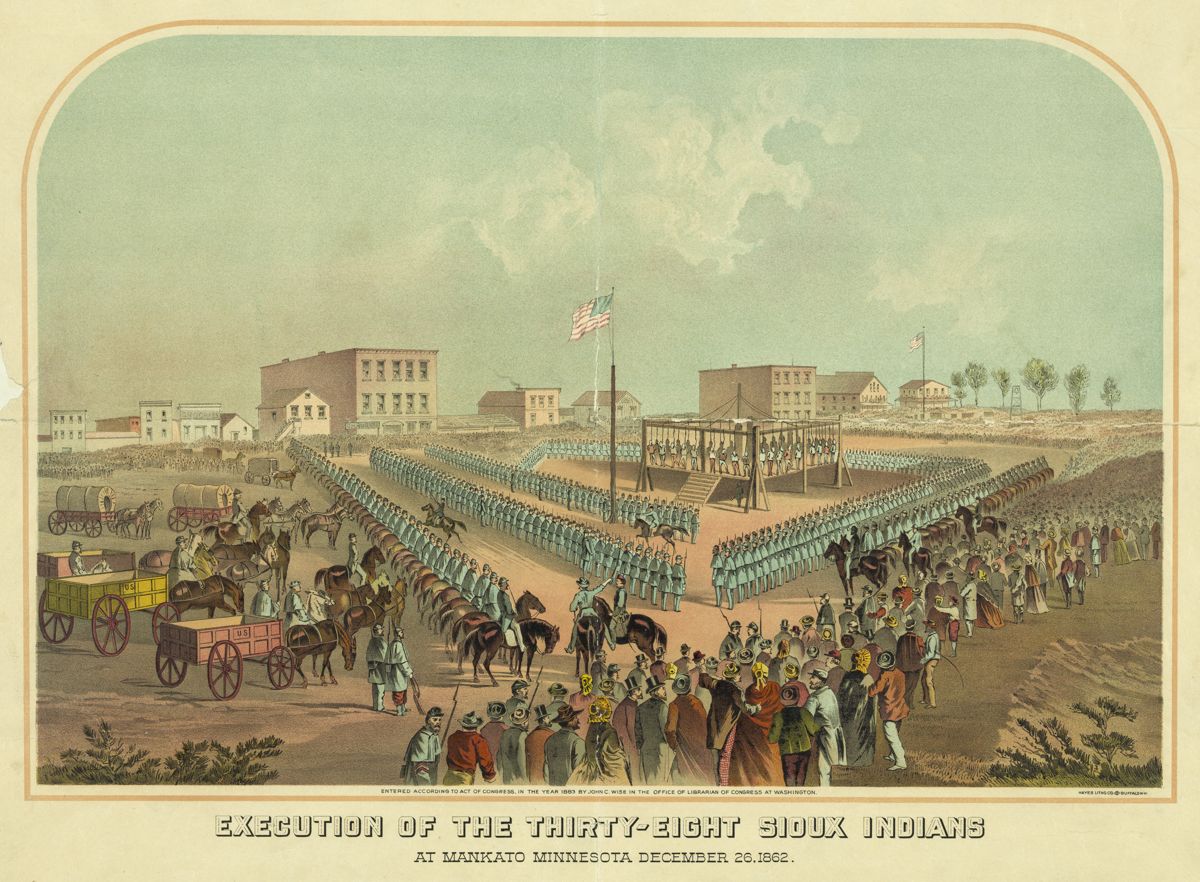
Execution of Sioux Indians The Graphic War highlights prints and printmakers from the Civil War discussing their meaning and the print maker or artist’s goals. Every American President has dealt with simultaneous multiple crises. No one’s plate was as full as Abraham Lincoln’s. In the fall of 1862, in the midst of the
“Great Rebellion,” the Union army was recovering from a second defeat at Bull Run, a questionable victory at Antietam, as Lincoln was contemplating the Emancipation Proclamation. He had fired his commander in the field George McClellan. In the first weeks of the month of December, the new commander of the Army of the Potomac, Ambrose Burnside was engaged in planning the disastrous Fredericksburg campaign and battle.
Adding to the Lincoln administration’s burden, the turmoil in the west was caused by a wave of white settlers seeking their “manifest destiny” clashing with the indigenous populations. The so called “Indian Wars” unleashed hatred and violence on both sides. In the summer of 1862, temperatures reached a boiling point. The Santee Sioux had been “badly mistreated by corrupt federal Indian agents and contractors.” During July, agents withheld food stores “because they had not yet received their customary kickback payments. The contractors callously ignored the Santee’s pleas for help.”1 The Administration’s Secretary of the Interior Caleb B. Smith in his annual report stated that in August of that year, “Sioux Indians, in Minnesota, attacked the settlements in their vicinity with extreme ferocity, killing, indiscriminately, men, women, and children. This attack was wholly unexpected, and, therefore, no means of defense had been provided. It is estimated that not less than eight hundred persons were killed by the Indians, and a large amount of property was destroyed.”2 Naively, Smith went on to wonder about the cause of the outbreak of violence and refused to speculate. He also recommended “remodeling” the Indian Policy but refrained from offering substantial specifics. He concluded with offering condolences to the people of Minnesota: “The State of Minnesota has suffered great injury from this Indian war. A large portion of her territory has been depopulated, and a severe loss has been sustained by the (Library of Congress)
destruction of property. The people of that State manifest much anxiety for the removal of the tribes beyond the limits of the State as a guarantee against future hostilities.”3 Anglo retaliation followed. In late September, General Henry Sibley led an expedition that defeated the Sioux at the Battle of Birch Coulee capturing most of the Indians. The perpetrators were tried before a commission consisting of five Federal officers: Colonel William Crooks of the Sixth Minnesota Volunteers, Lieutenant Colonel William R. Marshall of the Seventh Minnesota Volunteers, Captain Hiram P. Grant and Captain Hiram S. Bailey of the Sixth Minnesota, and Captain Rollin C. Olin, assistant adjutant general on Sibley’s staff. In December, the Senate asked President Lincoln for “all information in his possession touching the late Indian barbarities in the State of Minnesota, and also the evidence in his possession upon which some of the principal actors and head men were tried and condemned to death.”4 Lincoln responded with an even-handed approach. On the 8th of November he had received the names of those to be hanged and immediately asked for more information which he received and carefully sifted through. Lincoln made a distinction between those who had been involved in “massacres” and those involved in “battles.” He had been inclined to order the execution of those convicted of “violating females,” but discovered only two such individuals. A total of 40 Indians and half-breeds were convicted, 38 had participated in “massacres” and the two individuals were found guilty of rape. One of the number was recommended by the commission for “commutation to ten years’ imprisonment.” Lincoln ordered the execution to take place on December 19 listing in the order by name every condemned man totaling 39.5 Sibley wrote back that the 19th was too soon and proposed moving the execution forward to December 26. “The excitement prevails [in] all sections of the state & secret combinations Exist Embracing thousands of citizens pledged to execute all the Indians matters must be managed with great discretion & as much secrecy as possible to prevent a fearful collision between the U.S. forces & the citizens.” At the same time, Sibley acknowledged Lincoln’s order to exonerate Chakaydon, Chaska-don, Chaskay-etay, (alias Robert Hopkins) one of the original 40. On the approved day, 38 Sioux Indians and halfbreeds were hanged in Mankato at 10 AM, “Everything went off quietly, and the other prisoners are well secured” Sibley told the President.6 During the Civil War, no lithographer or printer documented the mass execution in Mankato, Mn. In 1882-83, John C. Wise published the only known depiction of the event. He was the “fiery editor” of the Mankato Record who “launched an ‘extermination or removal’ campaign directed not at the Sioux alone, but also at the peaceful Winnebago.” Wise, a Democrat, maintained that the Lincoln administration and Republicans in general “listened to Eastern humanitarians rather than Western pioneers.” Wise commissioned the lithograph depicting the large squares within squares; the inner comprised of robotic looking soldiers, first infantry then cavalry and then an outer square of civilians. In the center is the large scaffold with the 38 doomed Sioux prisoners. Wise’s intention was to commemorate the 20th anniversary of the mass execution. As he told the readers of his newspaper when the deed was done: “All believe they richly deserved hanging, but as the President would not consent
CivilWarNews.com to this, the next best thing was to take them away. This has been done, and the people of our state and of this community especially are pleased with the riddance.”7 The Indian wars continued well into the last quarter of the 19th century. Endnotes: 1.
Regulars: A History of the 121st New York Volunteers in the Civil War (U. Press Kansas, 2009). His two-volume Correspondence of Major General Emory Upton, (U. of Tennessee Press, 2017), received the 2017–2018

American Civil War Museum’s Founders Award for outstanding editing of primary source materials. Upton’s love letters to his wife 1868-70, (Till Death Do Us Part) was published in 2020 by the Oklahoma University
Press. His current book, From Antietam to Appomattox with Upton’s Regulars: A Civil War Memoir from the 121st New York Regiment published by McFarland Press will be released in April.
This Day in History, November 5, 1862. https://www.history.com/this-day-in-history/300santee-sioux-sentenced-tohang-in-minnesota Roy P. Basler, ed., The Collected Works of Abraham Lincoln. New Brunswick, Rutgers University Press, 1953, V, 525. Hereafter Basler, Lincoln. Basler, Lincoln, V, 526 Ibid., V, 550. Ibid., V, 542-543. Ibid., VI, 6-7 William E. Lass, “The Removal from Minnesota of the Sioux and Winnebago Indians,” The Minnesota Historical Society, Minnesota History Magazine, December 1963, 353, 354, 356-7. https://collections.mnhs.org/MNHistoryMagazine/articles/38/v38i08p353-364.pdf.
After 43 years in the museum field, Cilella devotes his time collecting American prints and maps and writing. His most recent books are Upton’s