
Tale of Two Eagles
By Michael Pikunas · Originally published October 2019 · pp. 28–29
Tale of Two Eagles By Michael Pikunas The morning of November 12, 1861, the youthful Federal soldiers of the 48th Pennsylvania Volunteer Infantry were not overjoyed by the unfamiliar sights and smells around them. They had landed at Hatteras Inlet, N.C., which compared to the lush green forests and farms of Eastern Pennsylvania, presented to them an endless and desolate expanse of bleached white sand. This was their first journey away from their homes in Schuylkill County, a region comprised of small coal mining towns near the Schuylkill River. One of those small towns, Palo Alto, lay on the Schuylkill which flows eastward toward Philadelphia, less than one hundred miles away. Just fifty miles to the east, was Bethlehem, settled in 1741 by a Christian sect of German Methodists called Moravians. These Germans “brought with them a high regard for education and a love for music.”1 But unlike their comrades from Palo Alto, the Bethlehemians had relatives and brethren in Bethania, N.C. Settled by Moravians in 1759; Bethania was a farm town near Salem, the Southern home of the Moravians. Like their northern brethren, the Bethanians enlisted to serve, not to put down the rebellion, but to don the Confederate gray and support it. The blue clad and gray clad Moravians had more than their patriotism in common; they shared a talent for music and their
Christian heritage, complete with its signs and symbols. “In their boarding schools they learned to draw their great Moravian symbol, The Star of Bethlehem. In this fashion, by drawing the shapes of a pyramid and gluing the shapes together they created a multi pointed star.”2 As the clouds of war darkened, many Moravians would join their respective ranks, not as soldiers, but as musicians. Following the first cannon blasts at Fort Sumter, Moravian musicians from Salem, formed three bands, initially named as militia units. “The Forsyth Grays” became Company E, Eleventh Regiment, NC Volunteers. This company changed later to the Twenty-first Regiment, NC Troops. The Bethania Brass Band also known as the “Confederate Stars” was formed soon after and became Company F, then Company I of the Thirty-third Regiment, NC Troops. Finally, there was the Salem Brass Band, famously known as the “26th NC Regimental Band.”3 They would all wear the gray. At Hatteras Inlet the young soldiers in blue eventually began to frolic in the surf, gathering what they called “secesh” shells. They’d ship the shells home to their relatives in wooden crates on board ocean borne “steamers.”4 They didn’t know what lay ahead, that three years hence their skills and ingenuity would be called upon to attempt a bold and decisive end to the seemingly endless war. The 48th Penna.
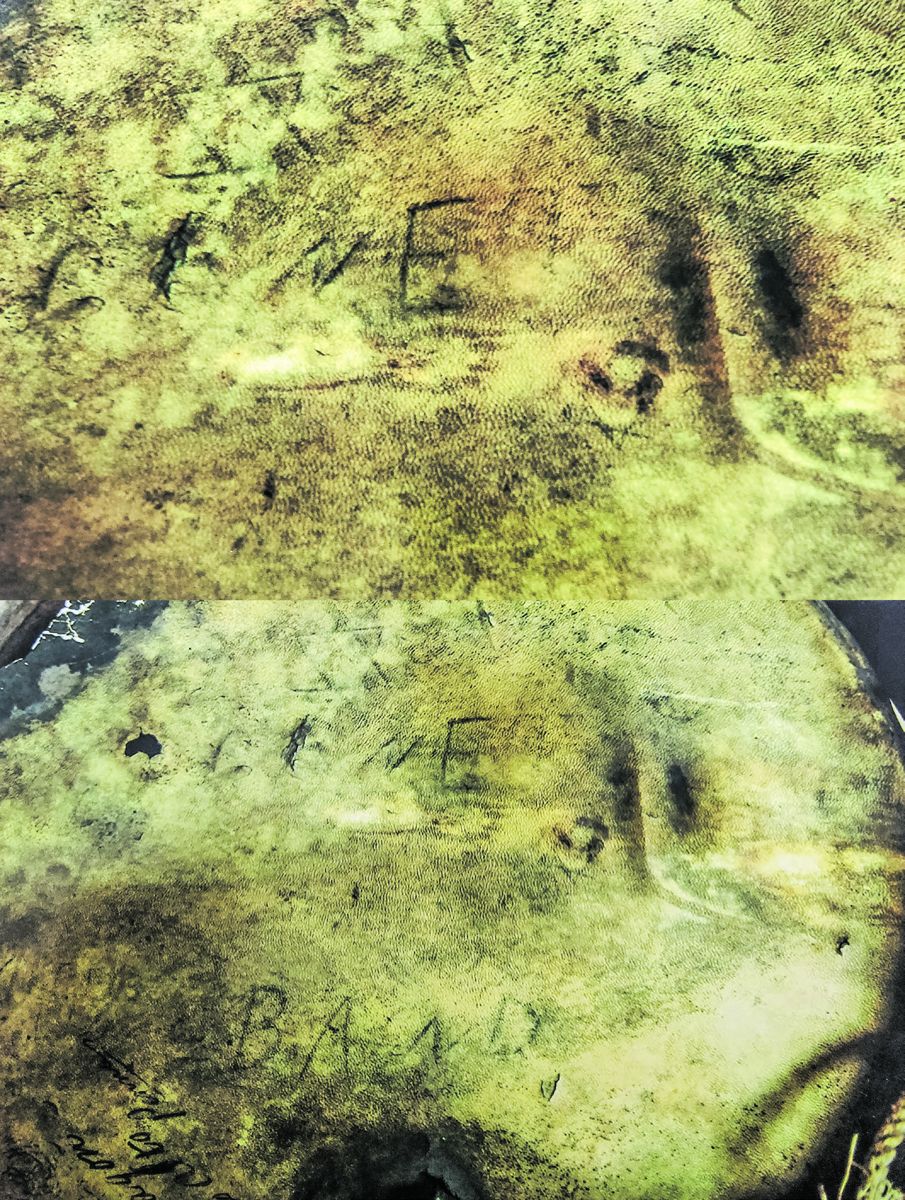
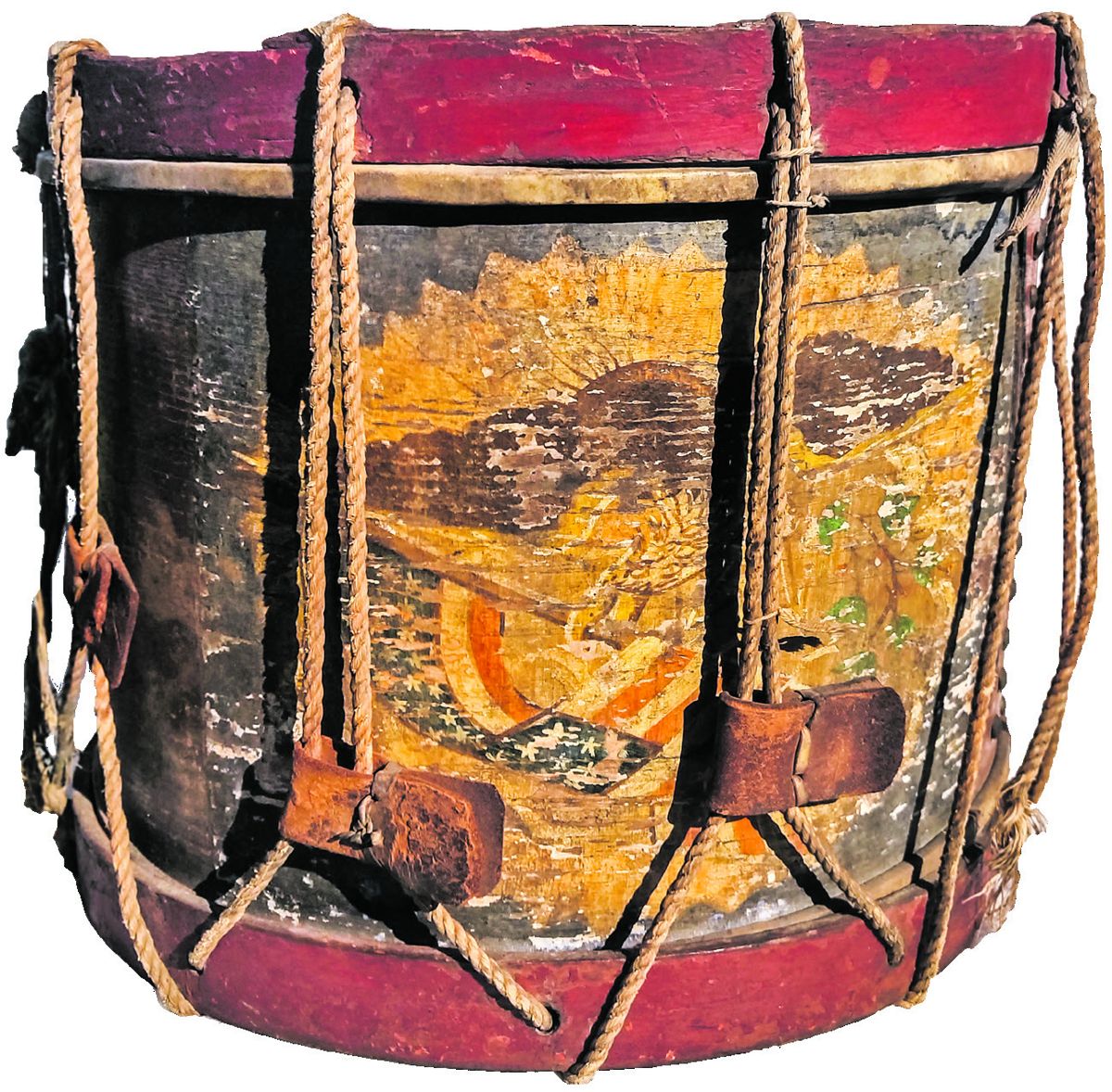
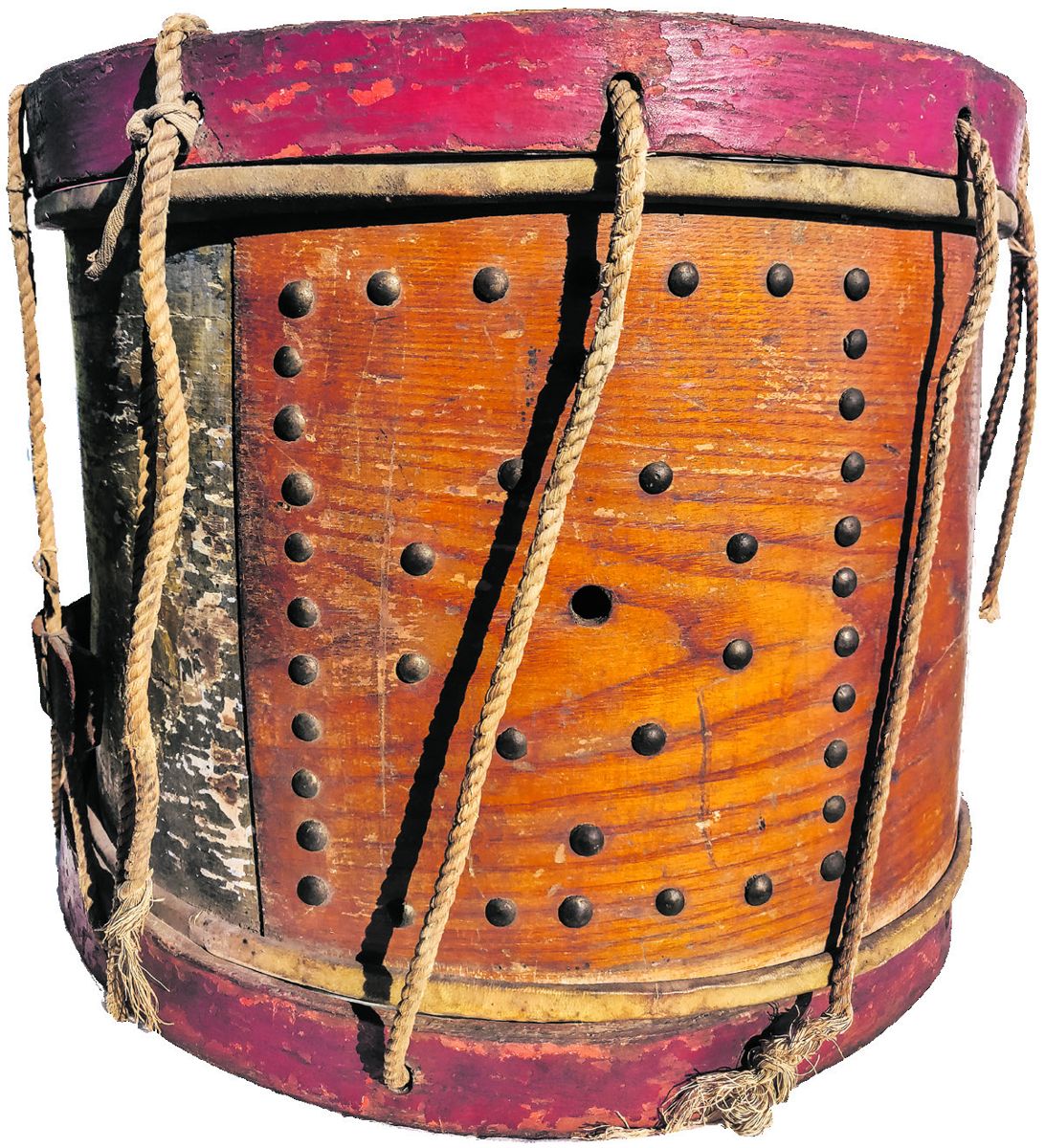
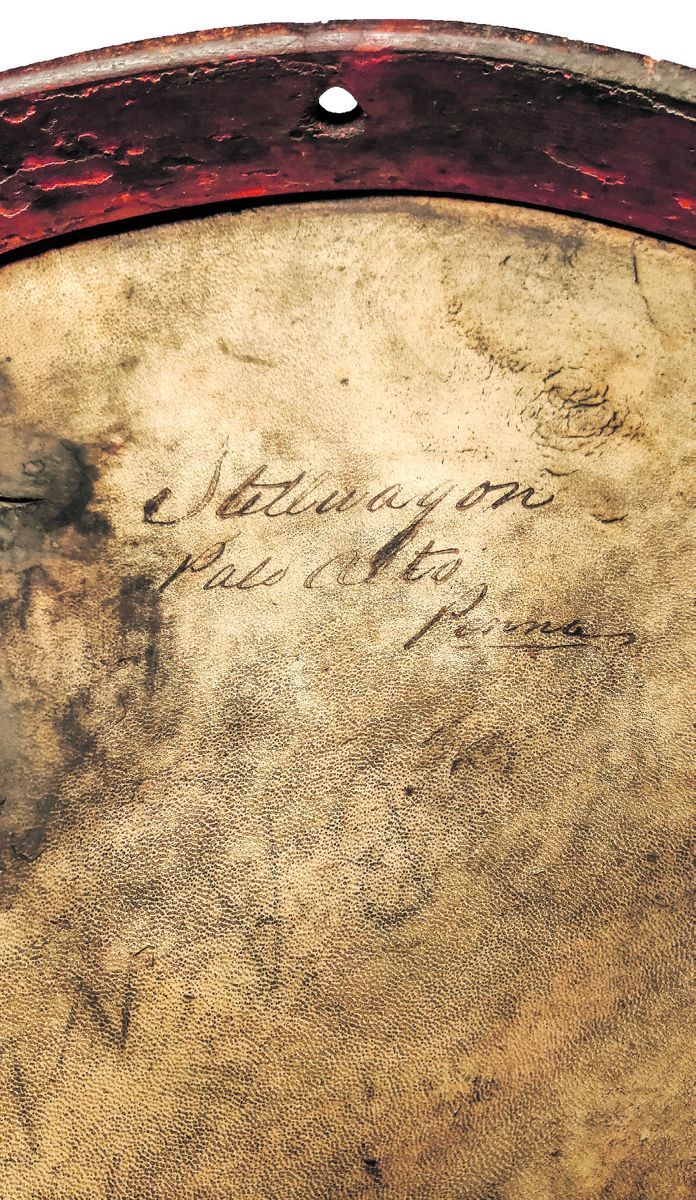
would tunnel underneath the rebel lines at Petersburg and plant a ton of explosives creating what would be known ever after as “The Crater.” Aside from making history, during the course of their war, the soldiers of the 48th Penn. would capture two American Bald Eagles, making them souvenirs and shipping them back home to Schuylkill County. “A live eagle was captured after putting up a fight on the 48th’s picket line at Hatteras Inlet.”5 The other was a defiant eagle, hand painted by an unknown artist on the face of a rebel snare drum captured late in the war. The bottom head of the ‘rebel eagle’ drum bears a number of six pointed stars, one of them large, “shaped in the same fashion as drawn by Moravian boarding school students in the mid-19th Century at Old Salem North Carolina.”6 Printed below the larger star by the same hand are two words LANE BAND. Appearing to the side of these markings in bold period ink is the name and home town of the soldier of the 48th Penn. who “captured” the drum and sent it home to Schuylkill County, (George W.) “Stellwagon, Palo Alto, Penna.” The drum’s dimensions are: 12 and one half inches tall by 14 and one half inches wide. The shell is uncut. Next to the spreadwinged eagle motif is a symmetrical tack pattern that consists of a circle around the vent hole encompassed by a large square. The hoops, heads, leather tugs, and rope tensioners are original. The free hand painted motif consists of a spread -winged bald eagle on a gold sun-rayed blue field. The bald eagle is grasping the broken flagstaff of a furled Federal flag in its beak. The eagle is portrayed on the ground with pointed green ivy leaves and red berries. In its talons is a clutch of arrows. The drum shows a substantial amount of use and field wear. It bears no Federal markings, i.e., E Pluribus Unum, U.S., etc. Images of original Federal drums carried by 48th Penn. drummers can be seen on the 48th Pennsylvania website.7 George Stellwagon, an infantryman of the 48th Pennsylvania, as far as we know, was with his regiment at the battles of Roanoke Island, New Bern, Second Bull Run, Chantilly, South Mountain, and Antietam, where he sustained a serious head wound while waiting to cross Burnside’s Bridge. Stellwagon recovered to re-join the 48th in 1864 for the Battle of the Wilderness and then to the war`s end. What is the meaning of the words ‘LANE BAND’? The words printed by the Confederate musician, represent the Confederate regiment and brigade to which the ‘rebel eagle’ drum belonged: the Thirty-third Regiment, NC
Troops of General James Henry Lane’s Brigade. General Lane received his brigadier star in November 1862 following the death of General Lawrence O. Branch at Sharpsburg. The Reminiscences of Oliver J. Lehman reveal the story.8 Known as “O. J.”, Lehman was a Moravian musician from Bethania, N.C., who enlisted in Lane’s Brigade and became band master to the Thirty-third NC Regimental Band. Lehman chose to serve with his fellow musicians who were formerly members of the Bethania Brass Band the “Confederate Stars.” “The Thirty-third Regimental Band although assigned to a regiment, was actually the brigade band for General Lane’s Brigade, which included the Seventh, Eighteenth, Twenty-eighth, Thirty-third, and Thirty-seventh N.C. infantry regiments.”9 The Brigade was attached to Pender’s Division, Third Corps, Army of Northern Virginia, under General Robert E. Lee. While the live bald eagle at Hatteras Inlet put up a ferocious fight before being captured by a lieutenant and two privates of the 48th Pennsylvania armed with a fusillade of sea shells, the eagle on the rebel drum of General Lane’s Band witnessed a much more prolonged and bloody struggle. We can only speculate that the rebel drum’ eagle heard the screams of wounded soldiers about to be consumed by flames in the woods at the Battle of Chancellorsville and witnessed the aftermath of the accidental wounding and death of General Stonewall Jackson caused by friendly fire from a sister regiment in Lane’s Brigade. We can only speculate how close it got to the battle line on Seminary Ridge before marching toward Cemetery Ridge at Gettysburg. Did it inspire those brave soldiers by playing their favorite tunes— Bonnie Blue Flag and Dixie? For it was General Lee who once said, “I don’t believe we can have an army without music.”10 We do know, according to Oliver Lehman that: “During all battles until the final surrender, General Lane’s Band was in the opening of each, caring for the wounded and taking them to the field hospital just behind the line of battle. So our duties were not only as musicians but also as ambulance corps. We were often under severe shelling and small arms fire but we escaped almost miraculously.”11 We can feel confident that the rebel drum was there when fate brought together the 48th
Pennsylvania and the Thirty-third North Carolina regiments. The eagle emblazoned on the ‘rebel drum,’ although forced to surrender has never surrendered its indomitable mystique. More of its story remains to be told. When all is quiet, an imaginative ear pressed against the vent hole might hear off in the distance the faint but unmistakable echo of the rebel yell. 1.
Endnotes:
Hall, Harry H. 2006. A Johnny Reb Band from Salem: The Pride of Tarheelia. Raleigh N.C.: Office of Archives and History, N.C. Dept. of Cultural Resources. Moravian Historical Society. About the Moravian Star, http://moravianhistoricalsociety.org. (accessed June 10, 2018). Hall, 2006. Hoptack, John David. 2017. The Civil War letters of Private Daniel Reedy, Company F, 48th Pennsylvania Infantry, http://48thpennsylvania.blogspot.com/p/letters-diaries-civil-war-letters-of.html. Hoptack, 2017. Moravian Historical Society. Hoptack, John David. 2017. The 48th Pennsylvania Volunteer Infantry, http://48thpennsylvania.blogspot.com. Lehman, O. J. Reminiscences of the War Between the States, unpublished manuscript. Raleigh, N.C.: North Carolina State Archives. Ferguson, Benny Pryor. 1987. The Bands of the Confederacy: An Examination of the Musical and Military Contributions of the Bands and Musicians of the
Confederate States of America. North Texas State University. 10. Gerard, Philip. 2011. Battle of the Bands, https://www.ourstate.com/civil-war-bands. 11. Lehman, O. J. Reminiscences of the War Between the States, unpublished manuscript. Raleigh, N.C.: North Carolina State Archives.
Acknowledgements I would like to recognize two persons in particular who helped me with their knowledge, expertise, and literary resources on the topic of Moravian Civil War history in Salem, North Carolina, namely, Historian Philip Dunigan and office manager Sarah Durham. The invaluable forensic and technical skills of my friend, Ed Carlini, is also acknowledged along with my sister Anne Marie “Bunchy” Schwelm`s, moral and literary support and assistance, and for the many years of sharing the joy of Our Great American History.
Michael Pikunas is recently retired (March 2017) from a 33 year career in Federal Law Enforcement. Born in Donora and raised in Pittsburgh, he has been fascinated with the American Civil War since reading many years ago a paperback copy of Combat: The Civil War – The Curtain Rises, by Don Congdon and Bruce Catton, many years ago. Soon after he stood on West Confederate Avenue at Gettysburg admiring the monuments and wondering that if the Southern Army was willing to come this far they must have been pretty serious. He continues to be an avid reader about the American Civil War and appreciates learning about and viewing the precious wartime relics preserved and shared by the collectors and historians of our times, especially Shannon Pritchard and Jack Melton.