This And That
L’audace, l’audace, toujours l’audace
By Gould Hagler · Originally published October 2019 · pp. 26–27
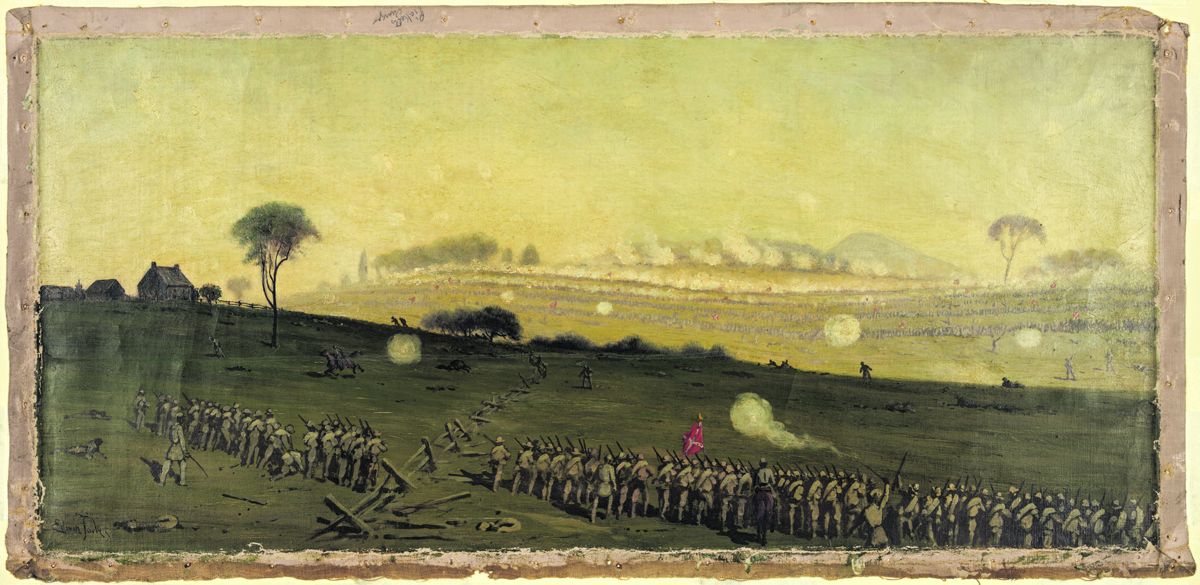
Edward Porter Alexander Edward Porter Alexander was a military professional, a keen observer, a thoughtful analyst, and a gifted writer. All these traits make his memoirs, Fighting for the Confederacy: The Personal Recollections of General Edward Porter Alexander (edited by Gary W. Gallagher and published in 1989), one of the best works of its kind. The account of how the memoirs came to be published is itself an interesting story. Alexander began to write in 1897, while in Greytown, Nicaragua, where he served 28 months as an arbitrator helping resolve a Central American border dispute. He intended the work for his own family, not for publication. He also “envisioned a modest work,” according to Gallagher, but the words kept flowing from his pen and filled 1200 handwritten pages, an account of the war and his role in it which “gave his children a precious legacy.” In 1901 Alexander started a second account, similar to the first, but different in scope and tone. Military Memoirs of a Confederate: A Critical Narrative was published in 1907. For much of the 20th century the account begun in Nicaragua remained hidden among the Alexander Papers at the University of North Carolina, mixed in with drafts of Military Memoirs. Scholars examining the papers didn’t quite know what to make of the confusing bundle. Finally Gary Gallagher took on the task of “disentangling this material.” The result was the 1989 book. One of the differences between the resurrected memoir and the 1907 work is its higher level of candor, what Gallagher calls “his unvarnished opinions about people and events.” High level leaders “and a host of lesser Confederates came in for substantial criticism.” This gets us to the column’s title, “L’audace, l’audace, toujours l’audace.” This phrase and variations of it are attributed to several people in history – Patton, Napoleon, Frederick the Great, and others. From my own knowledge I can say only that George C. Scott said it, but the point is there, whoever said it first: audacity is a highly desirable trait in a military commander. What did Alexander have to say about this trait as embodied by Robert E. Lee? In the early pages of Fighting for the Confederacy Alexander told of a conversation about Lee and audacity with Capt. Joseph Christmas Ives, a member of President Davis’s staff. After Gen. Joseph Johnston was seriously wounded at Seven Pines on May 30, 1862, the president named Lee to take Johnston’s place. Lee had not seen much success in his earlier assignments in western Virginia and on the South Atlantic coast. He was not a popular choice in all quarters. “And now that he was put into command of the army,” Alexander wrote, “some of the newspapers – especially the Richmond Examiner – pitched into him with extraordinary virulence, evidently trying to break him down with the troops & to force the president to remove him.” Alexander interrupted the narrative at this point to tell us an anecdote about the Examiner’s editor John Daniel, one his journalistic sins yet to be committed, and the wages to be paid. I will digress for the same reason. Soon after the war Daniel wrote a piece regarding a local lady, one Mrs. Grant, “with insinuations against the young lady’s character.” Mrs. Grant’s brother took offense at the editor’s words and “shot him dead on the sidewalk in front of his office from an upstairs window on the opposite side of the street. A Richmond jury afterwards acquitted him.” Lee would surely have reacted had Daniel made insinuations against any of the women of his family, but as the editor was assailing him; Lee paid the matter no mind. “Daniel’s attacks upon Gen. Lee were as bitter as he could make them, & were repeated almost daily,” Alexander wrote, but Daniel could not get a rise out of Lee. “I can’t recall any reply ever being made in any paper to these assaults,” Alexander said, “and Gen. Lee himself never seemed even remotely conscious of them.” Let’s return to the conversation with Ives and the matter of audacity. One day, after Lee’s assumption of command, Alexander encountered the captain as he rode from Richmond “to look around the camps & lines.” As they rode together they conversed freely about the state of affairs. Ives asked Alexander whether the criticism in the press was having an effect on the army’s confidence in its commander. “I replied,” wrote Alexander, “that I had, myself, seen no evidence of it, but that, being myself one of his staff officers, it would not be likely to be exhibited to me even if it existed.” Alexander in turn asked Ives a blunt question about his new boss, whom he did not yet know well. “Has Gen. Lee the audacity which is going to be required in the command of this army to meet the odds which will be brought against it?” Alexander summarized the situation for Ives, and it was a dire one. McClellan was at the gates of Richmond with a large force and with more men in the rear at Fort Monroe. McDowell was at Fredericksburg with close to 40,000 men, ready to pounce on Lee’s flank. “Here we are putting up some little lines in our front, but we are leaving the enemy to take his own time, & to perfect all his plans, & accumulate all his forces, & to choose his own battle…. Now with our inferior forces & resources such a course as that must finally end in defeat. Our only hope is to pounce on him & whip him somewhere before he is ready for us, and that needs audacity in our commander. Has Gen. Lee that audacity?” Alexander quoted Ives’s reply from memory, as he wrote in Greytown a third of a century after the fact. “Alexander, if there is one man in either army, Federal or Confederate, who is, head & shoulders, far above every other one in either army in audacity that man is Gen. Lee, and you will very soon have lived to see it. Lee is audacity personified. His name is audacity, and you need not be afraid of not seeing all of it that you will want to see.” Alexander did indeed see this audacity, at the upcoming Seven Days Battles and beyond. “I think that military critics will rank Gen. Lee as decidedly the most audacious commander who has lived since Napoleon,” wrote the old retired officer long after the young officer heard Ives’s prescient words. Alexander’s admiration of Lee is apparent throughout his narrative, but it is a candid work and Lee, like every other man, made mistakes. In Alexander’s view Lee on occasion exhibited too much audacity. His memoirs provide examples. First, at Sharpsburg, Lee stood with his army and faced a more numerous foe, against odds “so immense that the utmost he could have hoped to do was what he did do – to repel all assaults & finally to withdraw safely across the Potomac.” In Alexander’s estimation Lee “fought where he could have avoided it, & where he had nothing to make & everything to lose – which a general should not do.” Alexander made a similar assessment of Gettysburg. “Then perhaps in taking the aggressive at Gettysburg in 1863 & certainly in the place & dispositions for the assault on the third day, I think, it will be undoubtedly held that he unnecessarily took the most desperate chances & the bloodiest road.” We get his critique of the aftermath of Chancellorsville as well. The Confederates won a great victory on May 3; however, despite its losses the Army of the Potomac remained a very formidable force. “Hooker’s entire army, some 90,000 infantry, were in the Wilderness, backed against the Rapidan, & had had nearly three days to fortify a short front, from the river above to the river below. And, in that dense forest of small wood, a timber slashing in front of a line of breastworks could in a few hours make a position absolutely impregnable to assault. But on the afternoon of the 5th Gen. Lee gave orders for a grand assault the next morning by his whole force of about 40,000 infantry, & I was all night getting my artillery in position for it. And how I did thank God when in the morning the enemy were gone!” Alexander added this about the oversupply of audacity at
Chancellorsville: “I recalled ruefully Ives’s prophecy that I would see all the audacity I wanted to see, & felt that it was already overfulfilled: but, when to my intense delight, the enemy crossed the river in retreat during the night, & thus saved us from what would have been probably the bloodiest defeat of the war.” That was in the future, a year after Alexander’s conversation with Joseph Ives. Closer at hand was Lee’s audacious assault that drove McClellan from the Confederacy’s capital. Alexander’s memoirs cover that series of battles in great detail, and contain some frank assessment about their incomplete results. A future column will examine this assessment. Gould Hagler is a retired lobbyist living in Dunwoody, Ga. He is a past president of the Atlanta Civil War Round Table and the author of Georgia’s Confederate Monuments: In Honor of a Fallen Nation, published by Mercer University Press in 2014. Hagler speaks frequently on this topic and others related to different aspects of the Civil War and has been a regular contributor to CWN since 2016. He can be reached at gould.hagler@gmail.com.